Get Full Government Meeting Transcripts, Videos, & Alerts Forever!
Get email alerts on the Fy2026 Budget topic
No spam. Unsubscribe anytime.
San Diego City Council overrides several of Mayor Todd Gloria’s line‑item vetoes to adopt FY2026 budget
Summary
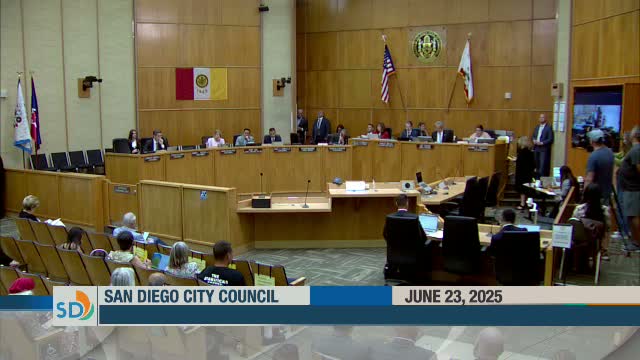
After hours of public comment and council debate over revenue assumptions, digital billboards, brush management and the Office of Race and Equity, the San Diego City Council on June 23 adopted a revised FY2026 budget by a 6–3 vote, overriding parts of Mayor Todd Gloria’s line‑item vetoes.
The San Diego City Council voted 6–3 on June 23 to override portions of Mayor Todd Gloria’s line‑item vetoes and adopt a modified fiscal year 2026 budget after extensive public comment and debate about revenue assumptions and program restorations.
Councilmember Jennifer Foster, chair of the budget committee, moved to override the mayor’s vetoes and restore the council’s June 10 funding decisions for libraries, recreation centers, lake restorations, community programs and several positions. Foster framed the motion as necessary to protect frontline services and community‑based organizations that the council said were at risk if the vetoes stood. “No across the board cuts to programs and services in libraries, parks, and recreation centers,” Foster said as she introduced the motion.
Why it matters: the dispute centered on whether the council’s restorations relied too heavily on speculative revenues and whether the mayor’s vetoes reflected prudent fiscal management. Independent Budget Analyst Charles Modica told the council the mayor’s veto removed roughly $4.4 million in council‑added expenditures, about $3.5 million in newly assumed revenues, and $1.4 million tied to five positions, and identified about $478,000 in other resources. Modica warned that several of the council’s revenue assumptions — including accelerated paid‑parking revenue and revenue from converting static billboards to digital displays — were optimistic and could increase the risk of midyear cuts if they did not materialize.
Mayor Todd Gloria urged the council to sustain his vetoes, saying the city faces a structural budget deficit and that overly optimistic assumptions would leave the city exposed to deeper cuts later. “Should this council choose to override my veto entirely, you are endorsing a level of risk that I cannot support,” the mayor said during opening remarks.
Key points and compromises: an initial motion to fully override the vetoes failed on a 4–5 vote. Councilmembers then considered an alternate motion from Foster that restored many council modifications while excluding or reducing some items tied to the most uncertain revenue sources. The adopted compromise restored funding for libraries, parks, recreation centers and all nine city reservoirs, preserved several community grants, and funded specified positions, while trimming or excluding items that depended on the $3 million billboard digitization projection and other contested assumptions.
On the Office of Race and Equity, the adopted motion included a transfer of some positions back to a council‑supervised structure but also prompted discussion about whether moving the office into the Independent Budget Analyst’s office would require municipal‑code or charter action. The IBA warned that some responsibilities of the Office of Race and Equity — such as hiring and contracting fairness work — may be difficult to accommodate without further structural changes.
Public input: more than 30 in‑chamber speakers and dozens of written comments urged councilmembers to override the vetoes and restore funding to community programs, arts and culture grants (CPPS and ACCF), stormwater contingency, brush management and homeless outreach. Speakers frequently warned that cuts would disproportionately harm low‑income and BIPOC communities; others urged caution on relying on billboard revenue. For example, speaker Tristan Biri urged the council to “override the entirety of this budget veto” and protect restored community programs. Several community organizations (including Friends of the San Diego Lakes and Trans Family Support Services) testified in support of restorations for lakes, cultural funding and youth programming.
Vote at a glance: the compromise override motion carried 6–3. The clerk recorded that Councilmembers Campbell, Whitburn and Moreno voted no; the motion was moved by Councilmember Foster and seconded by Council President Pro Tem Lee.
What’s next: Council President Lacava said the adopted budget “as modified by the council today shall become the adopted budget for the 2026 fiscal year,” and emphasized this is the beginning of implementation work, with anticipated further monitoring and adjustments during the fiscal year. The council instructed staff to docket follow‑up items necessary to implement the restored programs and to monitor revenue and overtime pressures identified by the IBA.
Details and caveats: figures discussed by staff and speakers included IBA estimates and public testimony numbers. The IBA identified the principal fiscal risks as optimistic overtime projections for public safety, volatility in sales and transient occupancy tax revenues, and assumptions that require future administrative or negotiating steps (for example, paid parking and negotiated zoo parking revenue). Several public commenters quoted detailed figures for specific grants or contingency funds (for example, citing amounts for CPPS and stormwater contingency); those figures were presented by speakers and appear in the record as attributed comments rather than independent staff confirmations.
The council adjourned to its next regular meeting on June 24, 2025, at 10:00 a.m.