Get Full Government Meeting Transcripts, Videos, & Alerts Forever!
Get email alerts on the Public Art Veterans Memorial topic
No spam. Unsubscribe anytime.
Carlsbad subcommittee selects Gordon Huether to design Veterans Memorial Park public art
Summary
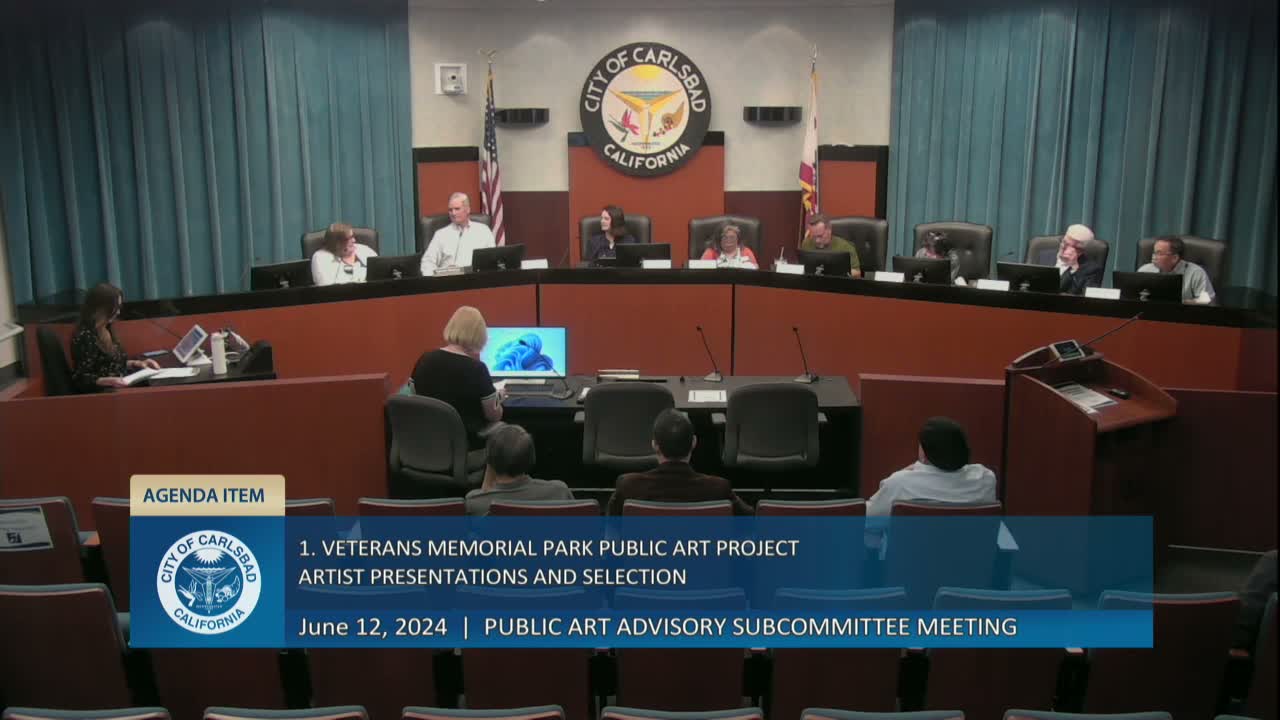
After hearing four finalists’ presentations and questioning artists about engagement, site responsiveness and maintenance, the Public Art Advisory Subcommittee voted 5–2 on June 12, 2024, to recommend Gordon Huether Studio to design the Veterans Memorial Park public art piece; staff will pursue a design agreement and forward the recommendation to the Arts Commission and City Council.
The Public Art Advisory Subcommittee voted 5–2 on June 12, 2024, to recommend Gordon Huether Studio as the artist to design a public art installation at Carlsbad’s forthcoming Veterans Memorial Park.
The decision followed a special meeting in which four finalists — Gordon Huether (Gordon Huether Studio), Po Shu Wang (Living Lenses), Mark Ehling (MGA Sculpture Studio) and Norman (Site) Studio — each gave 15-minute presentations and answered the subcommittee’s supplemental questions. Interim Cultural Arts Manager Fiona Everett told the panel the park construction budget is currently about $450,000 and that the city’s municipal code dedicates 1% of certain construction costs to public art; the park construction is anticipated in 2026.
Why it matters: The subcommittee chose an artist who, members said, demonstrated both large-scale fabrication experience and sensitivity to the site’s natural setting. The selected artist will develop a design agreement with city staff, then seek final approvals from the Arts Commission and City Council before any contract is negotiated.
What the finalists proposed and how committee members reacted Gordon Huether emphasized experience with memorials, collaborative community workshops and integrated lighting and landscape work. “I really understand that this is a super high-profile project and respect and understand and support the public transparent process,” Huether said during his presentation, describing case studies in which community workshops shaped commemorative details.
Po Shu Wang presented an interactive, multisensory approach focused on “serenity, contemplative space, interactive engagement,” and described using sensors, projection and audio elements to convert community input into an experiential design. Wang said his work aims to make the memorial a place people actively engage with rather than only observe.
Mark Ehling described MGA’s in-house, turnkey fabrication capacity, explaining the studio handles concept through installation and has equipment and fabrication shop capabilities that allow it to test structural and transport logistics before site assembly. “Everything that we do starts with concept development, and I generally do a deep dive into an area, into its history, the cultural significance, the community where the sculpture’s going to be placed,” Ehling said.
Norman (who introduced himself as Norman Lee) framed his practice as “narrative placemaking,” stressing listening sessions and iterative outreach to distill disparate community inputs into a single, site-specific design that can incorporate local stories and rituals.
Deliberations and the vote Committee members repeatedly raised the importance of responding to the park’s hilltop site, the ocean and lagoon views, and the need for a piece that could read at the scale of the park while remaining meaningful at close range. Some members favored more abstract, experiential work; others prioritized a design approach that would be immediately legible to a range of veterans and family members.
Subcommittee Member Donald Armento moved to select Gordon Huether Studio; Jen Belknap seconded. The motion passed 5–2. The minutes record the outcome as “motion passes 5 to 2.” The meeting minutes do not list individual roll-call votes by member name in the transcript.
Questions of inclusivity, maintenance and scale During questioning, members asked whether and how finalists would reflect the full diversity of veterans, including LGBTQ veterans, and how interactive or technological components would be maintained. Artists uniformly said inclusivity would be addressed through community engagement rather than by superficially “checking boxes.” On maintenance, presenters described using off‑the‑shelf electronic components where possible, designing for site durability, and providing documentation and replacement parts as part of standard project closeout.
Next steps Staff will work with Gordon Huether to execute a design agreement. That recommendation will go to the Arts Commission and then to the City Council for final approval before contract negotiations and detailed design work proceed. The subcommittee’s recommendation is advisory; council approval and any contract are subject to subsequent review and authorization.
Meeting context and procedural notes The subcommittee opened this finalist selection phase after reviewing 35 qualified artist submissions and narrowing them to four finalists at a prior meeting. The panel’s decision on June 12 is the subcommittee’s recommendation for the design contract only; the city’s standard follow-up approvals and procurement checks remain.
— Reporting for the City of Carlsbad Public Art Advisory Subcommittee meeting, June 12, 2024.