Get Full Government Meeting Transcripts, Videos, & Alerts Forever!
Get email alerts on the Windsor Point topic
No spam. Unsubscribe anytime.
Carlsbad council presses Affirmed/Con Am over Windsor Point security after police find unsecured doors
Summary
Council received a staff report and a police chief’s on‑site account showing unvetted access at Windsor Point, directed the city manager to review management agreements and the management/security plan, and set a return report for Oct. 22 after heated public comment and presentations from county, Affirmed Housing and Con Am.
Council members and city staff spent the longest portion of the July 16 meeting on Windsor Point, a two‑site affordable housing project that neighbors and officials say has generated outsized public‑safety concerns.
Housing and homeless services director Mandy Mills told the council Windsor Point comprises two buildings (965 Oak, 3606 Harding), 48 rented units (plus two manager units), and a mix of tax‑credit affordable units and No Place Like Home units for residents with serious mental illness. The city purchased half the land and entered a long‑term ground lease with Affirmed Housing; Affirmed hired Con Am to manage the property, Mills said. County behavioral‑health and housing funds, tenant services from Interfaith Community Services and other programs also support the project.
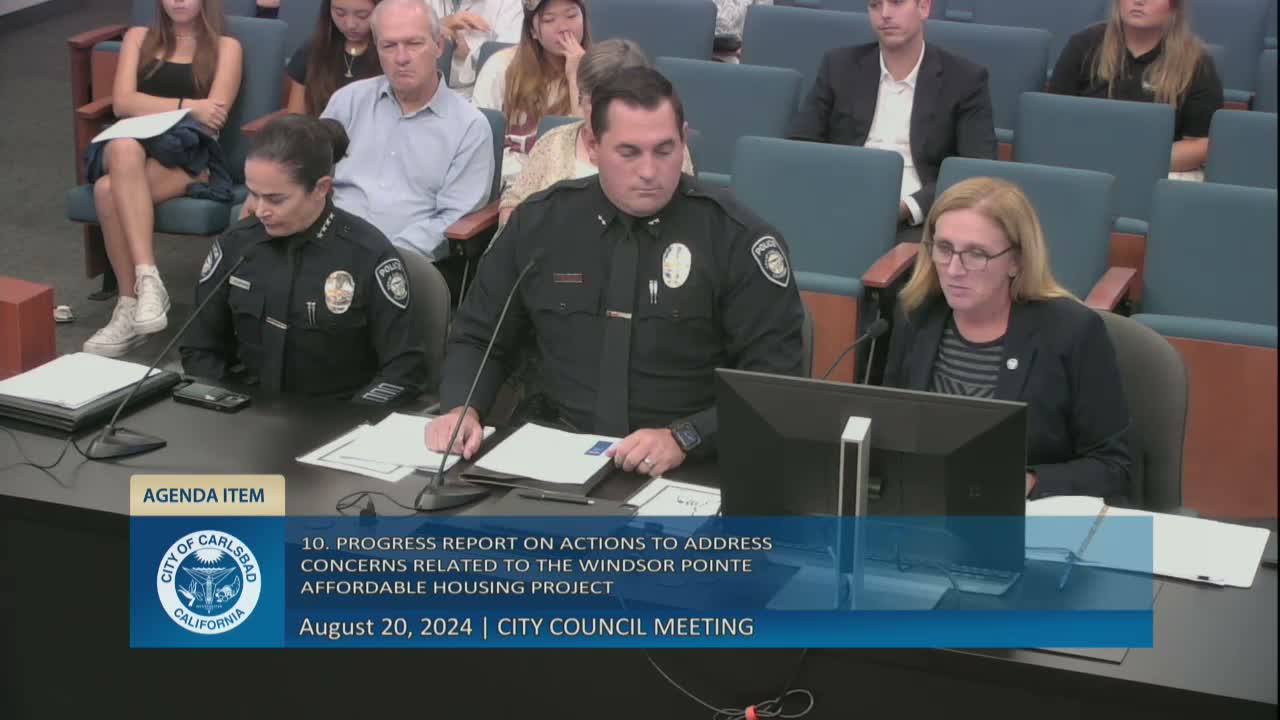
Police Chief Christy Calderwood told the council that during an early‑morning visit the same day she was able to follow a woman through a gate labeled “emergency/exit only,” enter multiple interior doors that appeared locked and find evidence that someone had been sleeping near a stairwell. Calderwood said she called the vendor listed on the video monitoring sign and was told staff “don’t really look unless somebody reports something,” a statement she said contradicted the city’s understanding that monitoring was live. She described leaving voicemail messages and not getting a timely property‑management response, then driving to the other site and speaking with a Con Am employee who acknowledged the doors could be forced open.
Calderwood asked council to require immediate hardware fixes, additional planned police patrols, security audits, and lease enforcement when warranted. City staff said they had already requested improvements to doors and gates, sought more routine on‑site patrols, arranged security audits by police and asked the county to increase on‑site supportive services. Mills said tenant peer‑support hours had been increased by 20 hours a week (to 44 hours) and county behavioral‑health staff had been given mental‑health first‑aid training.
The police department presented data covering March 1–July 31 showing 222 calls for service tied to Windsor Point in that period, 115 of which resulted in non‑responses (handled via phone or diversion), and eight crime cases requiring further investigation. The presenter said roughly 80% of calls were noncriminal (mental‑health or service needs) and that the city and county have increased referrals to a mobile crisis response team (MCRT).
County Supervisor Lawson‑Reamer’s senior policy advisor, Christina Selder, told the council the county does not control whether the project stays open and that the city controls the lease; she said the county has increased on‑site funding for security and case management and expanded training and services to support the project’s success.
Multiple neighbors and community members testified at length about theft, parties, and high numbers of calls for service; several urged the council to remove the management agent, repurpose the buildings, or close the project. One speaker cataloged prior incidents that residents had circulated to council.
Affirmed Housing’s VP Jonathan Taylor and Michelle Seitz of Con Am said management is investigating the access incident, has bids to strengthen gate and door hardware, and is reviewing procedures with the third‑party live camera monitor (Stealth Monitoring). Taylor described the monitoring system as newer technology that sends alerts and allows two‑way contact, but pledged to investigate why it did not prevent the incident the chief described.
Several council members expressed frustration at repeated promises that they said have not been fulfilled, and directed the city manager to: review the ground‑lease and regulatory agreements for remedies; evaluate whether the management agent is meeting contractual obligations and whether the city has grounds to require a change of management; review and, if needed, amend the management plan and security plan; and provide cost estimates for 24‑hour, in‑person security coverage. Councilmember Burkholder moved the directions, the motion was seconded, staff agreed to return with amendments and cost information by Oct. 22, and the motion passed.
What happens next: staff said they would put Affirmed/Con Am on notice for deficiencies in the management plan, pursue management‑plan revisions and contract remedies as appropriate, continue security audits and patrols, and report back to council on Oct. 22 with recommended actions and cost estimates.
Notes: The county’s No Place Like Home funding and regulatory restrictions were discussed (panelists referenced a 55‑year regulatory term and a 20‑year operating‑subsidy commitment). The city attorney advised that council’s motion should be based on the security information presented (security lapses), not on call‑volume counts alone (calls for service are not themselves a legal basis for contract remedies).