Get Full Government Meeting Transcripts, Videos, & Alerts Forever!
Get email alerts on the Tenant Utility Protections topic
No spam. Unsubscribe anytime.
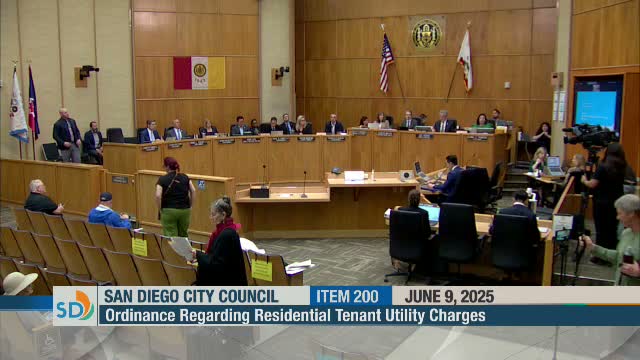
Council approves ordinance limiting landlord passthrough of city utility charges
Summary
The City Council unanimously approved a D9‑sponsored ordinance that lets landlords pass through only the city utility fees they actually pay, requires advance notice and documentation, and provides tenants with enforcement remedies; stakeholders asked for further transparency and caps on third‑party billing fees.
The San Diego City Council on June 3 unanimously adopted an ordinance that restricts how landlords pass through city utility charges to residential tenants. The measure, moved by Councilmember Ilo Rivera and seconded by Councilmember Moreno, passed 8–0 (Councilmember Campbell absent).
The ordinance allows landlords to charge tenants only the amount the landlord actually pays for tenant‑consumed city utility services — defined in the ordinance as water, sewer, stormwater and solid waste management — and requires written notice and supporting documentation when landlords impose such passthroughs. Tenants have a right to request the landlord’s utility bill or a link to tax‑roll billing data, and landlords must respond with the requested documentation within 10 calendar days. If a landlord uses a third‑party billing service, the ordinance requires identification of administrative fees passed through to tenants and explicit disclosure of those charges.
Jeffrey Nguyen, policy advisor for District 9, told the council the ordinance was designed to protect renters from being overcharged as the city implements cost recovery for solid waste following Measure B. "The purpose of the proposed residential tenant utility charge ordinance is to promote fairness, equity and transparency regarding how landlords pass through utility fees to tenants," Nguyen said.
Tenant advocates, legal aid and labor groups supported the ordinance and proposed strengthening amendments. Alliance San Diego and the Legal Aid Society urged two specific additions: (1) require landlords to automatically provide the master utility bill to tenants (rather than waiting for a tenant request) and (2) prohibit or cap pass‑through of third‑party administrative billing fees so tenants are not charged for a landlord’s choice to use a billing service. The city’s stakeholder outreach prior to the hearing included landlord and industry input; the California Apartment Association and rental housing groups said a 90‑day compliance window and clear implementation guidance were necessary for large property owners to comply.
Supporters argued the ordinance increases transparency and prevents landlords from profiting off city‑provided utility charges. Opponents cautioned against limiting third‑party billing in ways that could complicate cost recovery for large buildings. Several speakers asked the council to require that a landlord’s violation be an explicit defense in unlawful‑detainer (eviction) proceedings; Legal Aid suggested adding that language to make it harder for tenants to face eviction for disputed utilities charges.
Councilmembers praised staff outreach and stakeholder negotiation. The ordinance requires written notice of passthrough charges, documentation on request, and enumerates civil remedies available to tenants. City staff said they will provide implementation guidance and a 90‑day compliance window.
The adoption adds a tenant‑protections layer to the city’s broader utility and waste rate reforms and intends to reduce unexpected charges and improve billing transparency for renters.