Get Full Government Meeting Transcripts, Videos, & Alerts Forever!
Get email alerts on the Solid Waste Fee topic
No spam. Unsubscribe anytime.
San Diego Council adopts new solid waste fee after heated public hearing, 6–3
Summary
After more than three hours of testimony from over 100 speakers and a protest tabulation, the San Diego City Council approved a four‑year solid waste management fee schedule implementing Measure B by a 6–3 vote; supporters said the fee is needed to stabilize services and protect jobs, while opponents called it a bait‑and‑switch that will hurt seniors and low‑income homeowners.
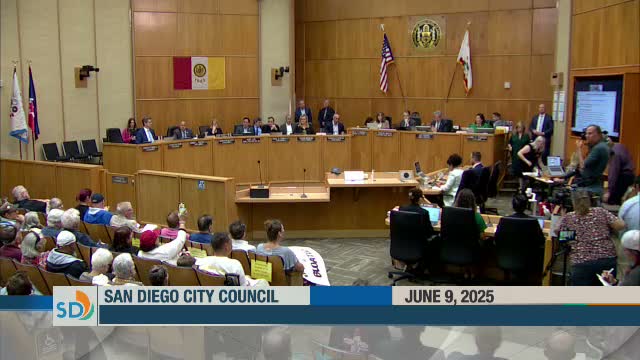
The San Diego City Council on June 3 adopted a new solid waste management fee and four‑year fee schedule intended to implement Measure B, voting 6–3 after a lengthy public hearing filled with more than 100 in‑person speakers. Councilmember Ilo Rivera moved the measure; Council President LaCava seconded. The motion passed with Councilmembers Campbell, Whitburn, Pro Tem Lee, Moreno, Ilo Rivera and LaCava voting yes and Councilmembers Foster, Von Wilpert and Campillo voting no.
The council’s action establishes a fee schedule with effective dates of July 1, 2025, July 1, 2026, July 1, 2027 and July 1, 2028, and includes a staff request that the fee adoption be found exempt from the California Environmental Quality Act. City staff and the Independent Budget Analyst briefed the council beforehand on operational findings, a cost‑of‑service study, and a range of options for rates and service bundles.
Interim Environmental Services director Kirby Brady told the council the proposal grew from a three‑round public outreach effort and an operational efficiency study that found the department needs a larger, newer fleet and replaced containers to provide reliable service. "We invited our team of consultants to understand how best to operate and what we need to improve," Brady said. He described a validated customer count of about 226,495 properties and outlined options that staff said would lower rates compared with earlier estimates by reducing reserve targets and phasing some enhancements.
Charles Modica, the independent budget analyst, told the council the IBA had explored options to lower rates and that the staff proposals reflected most of those alternatives. He warned that adopting a substantially lower fee than proposed would require service reductions or a general‑fund subsidy that would affect the city’s broader budget decisions.
More than 100 speakers filled the council chamber and overflow rooms during public comment. Many senior residents and homeowners said the final fee exceeds the $23–$29 range voters saw on the Measure B ballot and urged the council to reject or reduce the fee. "I'm a senior on a fixed income — I barely generate any trash — this is devastating," one speaker said. Others supported the fee, including AFSCME Local 127, which warned that rejecting the fee would jeopardize sanitation jobs and service reliability.
After public testimony, the clerk reported 46,456 written protests had been lodged, including 805 received during the hearing, and said the number appeared to fall short of the 50% plus one threshold required to halt the proposal under Proposition 218 procedures. Council debate focused on two central points: whether the city had a fiscal hole that required a new dedicated revenue source, and whether the fee as designed honored what voters approved under Measure B. Supporters said adopting the fee was necessary to avoid deep cuts to parks, libraries and other services; opponents described the process as a bait‑and‑switch that undermined voter trust.
The council approved the fee and directed staff to return June 24 with resolutions to authorize tax‑roll billing as the collection method and to remove existing container fees if the tax‑roll method is adopted. Staff also outlined a timeline for customer portal launch (July 15), container selection and October container deliveries.
The new fee will be billed via property tax roll if the council follows through with the June 24 items; staff said the city will offer a financial‑assistance program and return with details about eligibility and administration. The council’s adoption sets the rates and the implementation path while leaving some program and administrative details to follow‑up actions.