Get Full Government Meeting Transcripts, Videos, & Alerts Forever!
Get email alerts on the Pavement Management topic
No spam. Unsubscribe anytime.
San Diego transportation officials outline funding gap as pavement condition edges up to 65
Summary
Transportation staff told the City Council the city’s pavement condition index rose from 63 to 65 after heavier FY24–25 investment, but projected 10‑year funding gaps of $1.1–$1.2 billion mean the PCI could fall back without new revenue; councilmembers pressed for district breakdowns, contractor competitiveness, and expansion of in‑house paving crews.
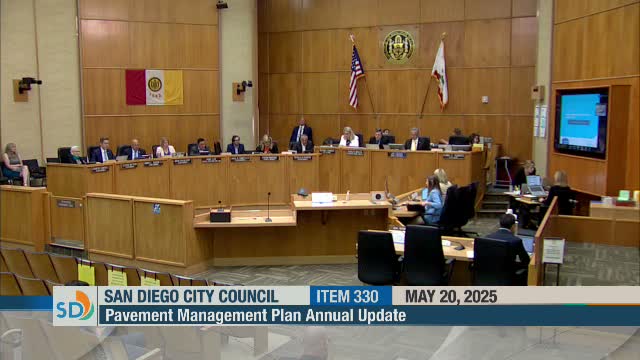
The San Diego Transportation Department reported to the City Council on May 20 that the city’s pavement condition index (PCI) has increased from 63 to 65 following heavier maintenance and rehabilitation work in fiscal years 2024 and 2025.
The presentation by Transportation Director Bethany Biesak and her team said the agency exceeded its annual paving mileage goals in FY24 and is aiming in FY25 to complete 300 lane miles of maintenance and 125 lane miles of rehabilitation via contractors, plus 20 lane miles of in‑house rehabilitation. The department ran three funding scenarios: the known funding projection (PCI falling to 53 by FY35), a scenario to maintain PCI 65 (10‑year need of $1.7 billion, a $1.1 billion gap), and a scenario to reach PCI 70 (10‑year need $1.9 billion, a $1.2 billion gap).
The staff presentation flagged rising bid costs — slurry seal bids up roughly 83% and asphalt overlay bids up roughly 90% since FY21 — contractor availability constraints and staffing and equipment shortages for the new in‑house mill‑and‑pave crews. The city added two new funded mill‑and‑pave teams for FY25; staff said seven operator vacancies remain on the additional team because of a hiring freeze and recruitment challenges for specialized operators.
The Independent Budget Analyst urged future updates to include PCI changes by council district and a clearer comparison of in‑house versus contracted cost‑per‑mile performance. IBA analyst Jordan Moore recommended the department publish metrics that show whether in‑house crews are more cost‑effective on comparable work.
Council members pressed staff on several issues: how to raise PCI in the worst districts, how the department selects streets for overlay, and why potholes reappear after rain. Biesak said the FY26 paving plan prioritizes overlay associated with other pipeline projects in lower‑scored districts and that the department’s crack‑treatment and hot‑mix pothole repair approaches are intended to extend pavement life. She confirmed unimproved roads are excluded from the PCI and require separate funding — staff estimated roughly $22 million per mile to fully improve an unimproved street compared with about $1.5 million per mile for a standard overlay.
Councilmember comments emphasized expanding in‑house capacity to control costs and the need for better contractor outreach to increase competition for large overlay contracts. The department said it plans additional outreach and that it has benchmarked contractor bid costs with adjacent agencies and remains on the lower end for many items.
The update was informational; no formal council action was required. Staff said the department will continue to refine the five‑year paving program on the city website, publish district‑level PCI progress in future updates, and return with further detail on in‑house performance metrics.