Get Full Government Meeting Transcripts, Videos, & Alerts Forever!
Get email alerts on the Budget Appropriation topic
No spam. Unsubscribe anytime.
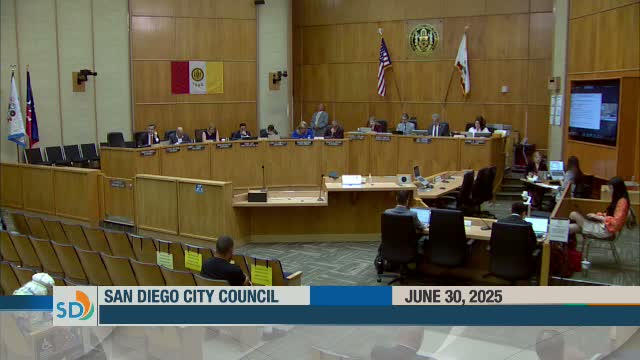
San Diego council adopts FY2026 appropriation ordinance after brief debate; measure passes 7–1
Summary
The San Diego City Council on June 30 adopted the fiscal‑year 2026 appropriation ordinance, finalizing the city’s budget framework, including updates to transient‑occupancy‑tax funds and restrictions on certain surveillance‑related contract expenditures. The measure passed 7–1.
The San Diego City Council adopted the fiscal‑year 2026 appropriation ordinance on June 30, finalizing the legal authority that will allow the city to operate under its $6 billion budget beginning July 1.
Department of Finance Assistant Director Ben Battaglia told the council the appropriation ordinance (AO) codifies the budget the council approved earlier in June and contains updates including three new transient occupancy tax (TOT) funds restricted to homelessness programs, street repair and convention‑center modernization, and limits on contractual expenditures for smart street lights and automated license‑plate readers (ALPRs) pending council review. “The adoption of the appropriation ordinance is the final step in the fiscal‑year 2026 budget process,” Battaglia said.
Why it matters: The AO establishes the legal control levels that authorize the mayor and chief financial officer to manage operational and capital spending. Staff said the AO also provides delegations for routine nonpolicy expenditures and is required by Charter section 69 to be adopted by June 30.
Council debate focused on outcomes and targeted restorations made during the budget process. Budget Committee Chair Council Member Foster highlighted restored Monday hours at 16 library locations, a $750,000 small‑business enhancement program and funds for parks and street lighting. Foster moved the staff recommendation; Council President Pro Tem Lee seconded.
Council Member Von Wilpert defended recent public‑safety committee work and oversight of ALPRs, saying the city has held public hearings and is tightening policies. “We had quite a robust hearing here in this chambers… Our privacy advisory board is currently working with PD to tighten those up as we speak,” Von Wilpert said.
Council Member Moreno was the lone no vote; the clerk recorded the motion as passing 7–1 with Council Member Campbell absent. The ordinance gives the CFO and mayor authority to control expenditures within the legal levels set by the AO and allows certain delegations of authority to streamline routine operations.
The council approved the AO as staff recommended; the ordinance was described by staff as necessary to “define the legal level at which the mayor and the chief financial officer are authorized to control operational and capital project expenditures.”
Next steps: With the AO adopted, staff will apply the ordinance’s delegations and proceed with implementing the FY2026 budget beginning the new fiscal year.