Get Full Government Meeting Transcripts, Videos, & Alerts Forever!
Get email alerts on the Grants Management topic
No spam. Unsubscribe anytime.
City auditor finds gains and gaps in San Diego's grants program, urges strategic plan
Summary
A performance audit presented Sept. 16 found San Diego increased grant awards from $271 million (FY2019) to $491 million (FY2023) but still lags peer cities on grant dollars per capita. Auditors recommended a citywide grant strategic plan, clarified review processes, formalized coordinator roles and a centralized grants repository; management agreed to all 13 recommendations.
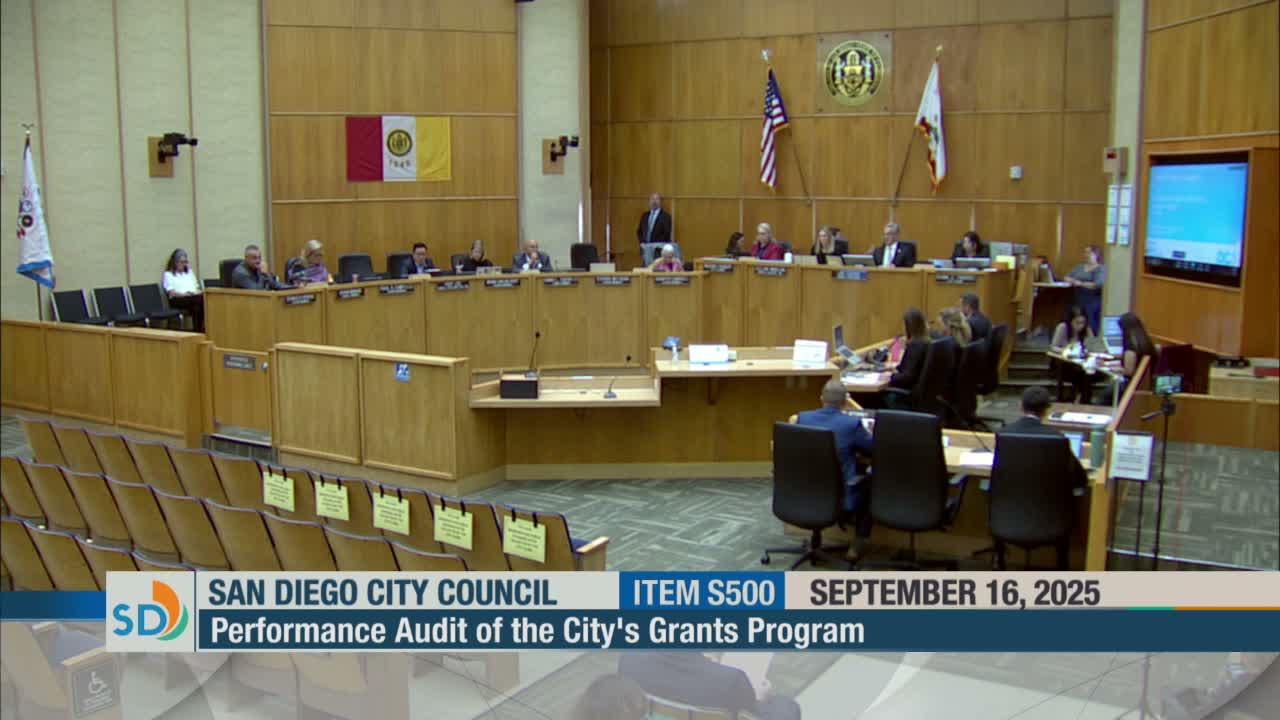
The San Diego City Auditor's office delivered a performance audit of the City's grants program on Sept. 16 that credited progress since 2018 but concluded the city remains less competitive than peer California cities on grant dollars per capita.
City Auditor Andy Henos opened the presentation, citing improvements that helped total grant awards rise from $271 million in fiscal year 2019 to $491 million in fiscal year 2023. The audit team said that, despite growth, other large California cities receive about 66% more grant dollars per capita, signaling "opportunities to build on the progress that has been made." Auditors said federal and state policy changes are shrinking some grant pools, increasing the importance of strategic targeting.
Principal Performance Auditor Megan Jaffrey and Performance Auditor Nadia Torquman described four broad findings: (1) the city lacks an explicit, citywide grant strategic plan to coordinate priorities and capacity; (2) the grant review process (the executive Grants Review Team or GRT) is not consistently used by departments and tracking is uneven; (3) roles and responsibilities for grants program coordinators added in 2023 require clarification in administrative regulations; and (4) training and institutional knowledge preservation (a repository of applications and debrief notes) are needed to reduce churn and improve competitiveness.
Recommendations included developing and publishing a grants strategic plan that captures department priorities and matching fund constraints, finalizing a decision checklist (go/no-go tool) for grant readiness, clarifying coordinator roles in administrative regulation 1.8, improving GRT tracking and reporting, and building a central grants library to house applications, debriefs and lessons learned.
Management agreed to all 13 recommendations and said some items are already underway. Walt Bishop of the mayor's office told the council his team had moved the grants review process onto OnBase and reorganized staff under Government Affairs; he said the mayor's grants team expects to complete non-budgetary recommendations by mid-2026 and will continue aggressive pursuit of available funding.
Council members pressed auditors and mayoral staff over several issues: (a) how the city compares to other cities (auditors relied on cities' comprehensive financial reports for apples-to-apples benchmarking); (b) whether grant losses reflected weak applications or strategic misalignment (auditors noted their scope was higher-level but recommended debriefs and a central repository so departments can capture vendor/funder feedback); and (c) the need for matching funds and department buy-in to pursue capital grants that require large local matches. Council Member Moreno cited La Media Road as an example of coordinated pursuit of a multi-million dollar grant.
The audit team committed to supporting implementation and auditors said management had agreed with all recommendations. Council members and the mayor's office discussed timing and incorporation of a grants strategic plan into the city's annual budget process with a target of July 2026.