Get Full Government Meeting Transcripts, Videos, & Alerts Forever!
Get email alerts on the Labor Wage Policy topic
No spam. Unsubscribe anytime.
San Diego council adopts hospitality minimum wage, phases to $25 by 2030
Summary
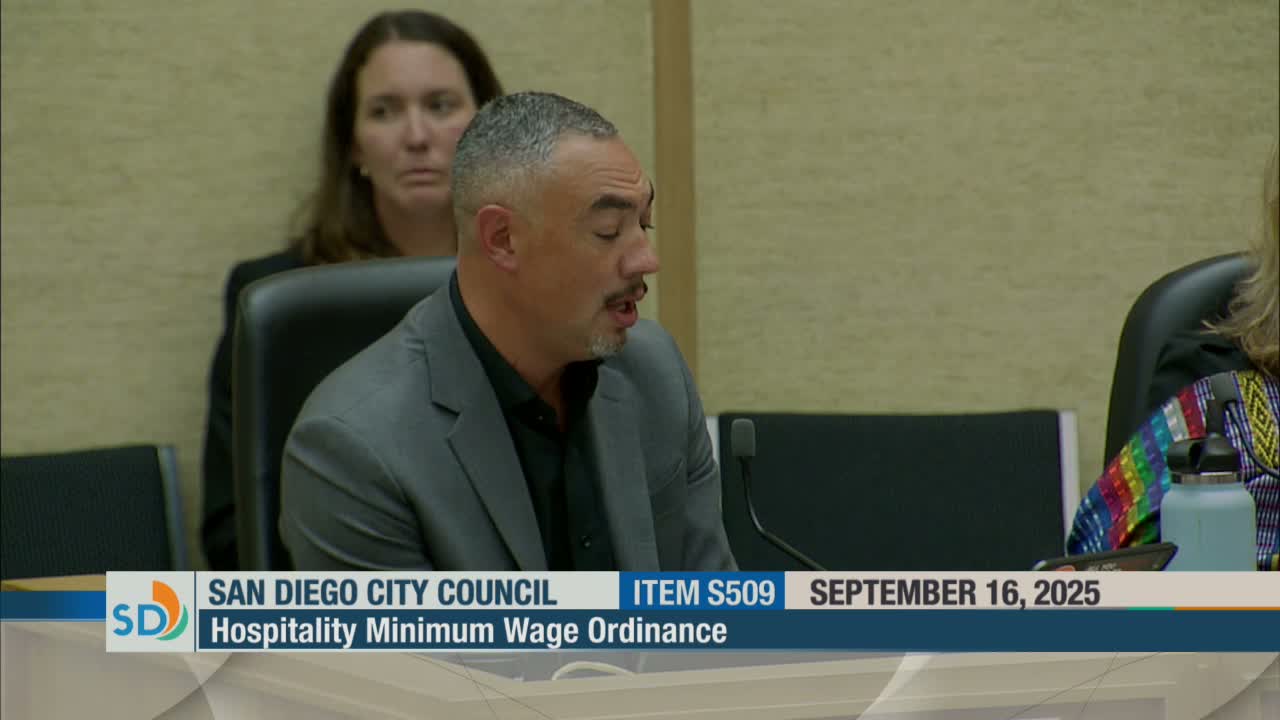
The City Council voted unanimously Sept. 16 to adopt a hospitality minimum wage ordinance covering certain large hotels, event centers and amusement parks in San Diego, phasing the wage up to $25 an hour by 2030 and adding worker protections and enforcement provisions.
The San Diego City Council on Sept. 16 voted unanimously to adopt an ordinance that establishes a new hospitality minimum wage for certain hotels, event centers and amusement parks within the city's boundaries, phasing in to $25 per hour by 2030 and indexing thereafter for inflation.
The ordinance, introduced by Council Member Ila Rivera and presented by her deputy chief of staff Maya Rosas, targets large hospitality employers — defined in the draft as hotels with at least 150 guest rooms, specified event centers and amusement parks — and on-site businesses that operate "on the grounds" of those facilities. The measure phases wages upward beginning July 1, 2026, and includes anti-retaliation protections, an employee complaint process and enforcement by the city's Office of Labor Standards and Enforcement.
"San Diego should work for San Diegans," Maya Rosas said during the presentation, citing regional data on tourism and the high cost of living that leaves many hospitality workers unable to afford to live in the city where they work. Rosas said the ordinance applies to restaurants, bars, banquet halls, retail shops, parking facilities and other services on hotel grounds; it also addresses event centers such as Petco Park, the San Diego Convention Center, Pachanga Arena and the Civic Theater.
The council heard heavy public comment for and against the proposal. Labor and community groups representing housekeeping staff, stagehands and event workers urged passage, with union speakers arguing the increase would raise family incomes, reduce turnover and keep workers closer to their jobs. "Raising the floor for hospitality workers raises the floor for every worker in San Diego," said a union organizer from Unite Here Local 127 during public comment.
Representatives of hotel owners and downtown business groups urged caution. They said the measure would significantly increase labor costs for many operators at a time when tourism indicators have softened and warned of possible pass-through price increases, service reductions, automation or job cuts. The San Diego County Lodging Association and local hoteliers presented studies and testimony arguing the change could cost jobs and investment if not phased carefully.
The Independent Budget Analyst's office (IBA) presented benchmarking and economic analysis ahead of the vote. IBA staff concluded there is no clear consensus across economic studies about the magnitude of employment impacts from sector-specific minimum wages but noted that a $25 floor would raise wages for covered employees and could increase employer labor costs substantially in some cases. The IBA recommended a phased schedule and capacity for enforcement and estimated an initial compliance budget need for the city.
Council members stressed that phasing, targeted coverage and exemptions for smaller hotels were designed to reduce negative impacts while directing the wage increase to the lowest-paid workers in the sector. Council Member Foster, who seconded the motion, called the measure a step toward dignity and stability for workers; Council Member Whitburn and others highlighted the need to balance worker pay with the city's tourism economy.
Council Member Ila Rivera moved the staff recommendation with clarifying language about covered facilities and operations; Council Member Foster seconded. The clerk called the vote; the motion passed unanimously.
The ordinance includes an enforcement mechanism for employee complaints to the city's enforcement office, anti-retaliation protections, annual inflation adjustments after the phase-in and language to avoid overlap with the city's living wage ordinance for certain city facilities. The city compliance director said the department will refine resource estimates and, if needed, request additional funding in the FY27 budget to carry out outreach and enforcement.
Next steps: the ordinance's phase-in schedule begins in July 2026; the city will publish compliance guidance and the Office of Labor Standards and Enforcement will accept complaints and administer enforcement processes under the new rules.