Get Full Government Meeting Transcripts, Videos, & Alerts Forever!
Get email alerts on the Qanda topic
No spam. Unsubscribe anytime.
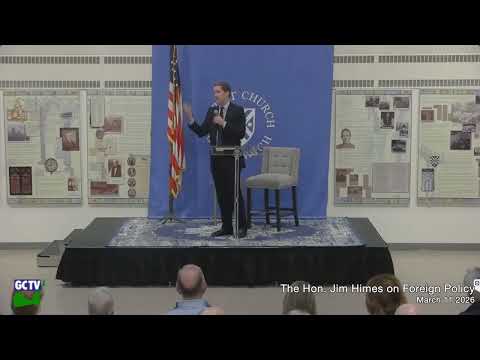
Town hall Q&A: Himes answers questions on Russia ties, sanctions waivers, cybersecurity and Iran
Summary
An extended question-and-answer at Christ Church featured audience questions about whether the president is a Russian asset, the sanction waivers for India, cybersecurity, Taiwan and the Strait of Hormuz; Rep. Jim Himes denied the president is an asset and said the White House waived sanctions to blunt domestic fuel-price pain.
Audience members asked a string of pointed questions about Russia, sanctions policy, cybersecurity and regional consequences of the Iran strikes. Representative Jim Himes answered briefly and directly, often warning that political pressures and practical constraints shape policy choices.
On a direct question — "Is the president of The United States a Russian asset?" — Himes responded: "No. I don't believe that. There's no evidence of that." He added that the president has a "deep rooted fascination with power and wealth," but declined to say the president was paid or controlled by Russia.
On waiving sanctions to allow Russian oil into India, Himes said the White House acted to reduce rising domestic gasoline prices and described the move as politically motivated: "The White House is absolutely terrified of what is happening right now," he said, noting gasoline costs and the political vulnerability they create.
On cybersecurity and personal devices, Himes emphasized individuals' role in basic hygiene (keeping devices updated, not clicking unknown links) and pointed to private technology firms as primary detectors when networks are compromised. On keeping the Strait of Hormuz open, he described an "asymmetry problem": inexpensive tactics (mines, small boats) can close the waterway and deter insurers, making assured passage difficult despite U.S. naval power.
Throughout the session Himes alternated short answers with longer clarifying remarks and repeatedly returned to the tension between short-term political incentives and long-term strategic consequences. The session closed after a final question about whether recent interventions represent a predictable pattern by the administration; Himes said he did not know the president's motives and expressed hope the administration would seek to reduce costs to citizens.