Researchers and Alaska Native leaders urge changes to limited‑entry permits to stem permit outmigration
Loading...
Summary
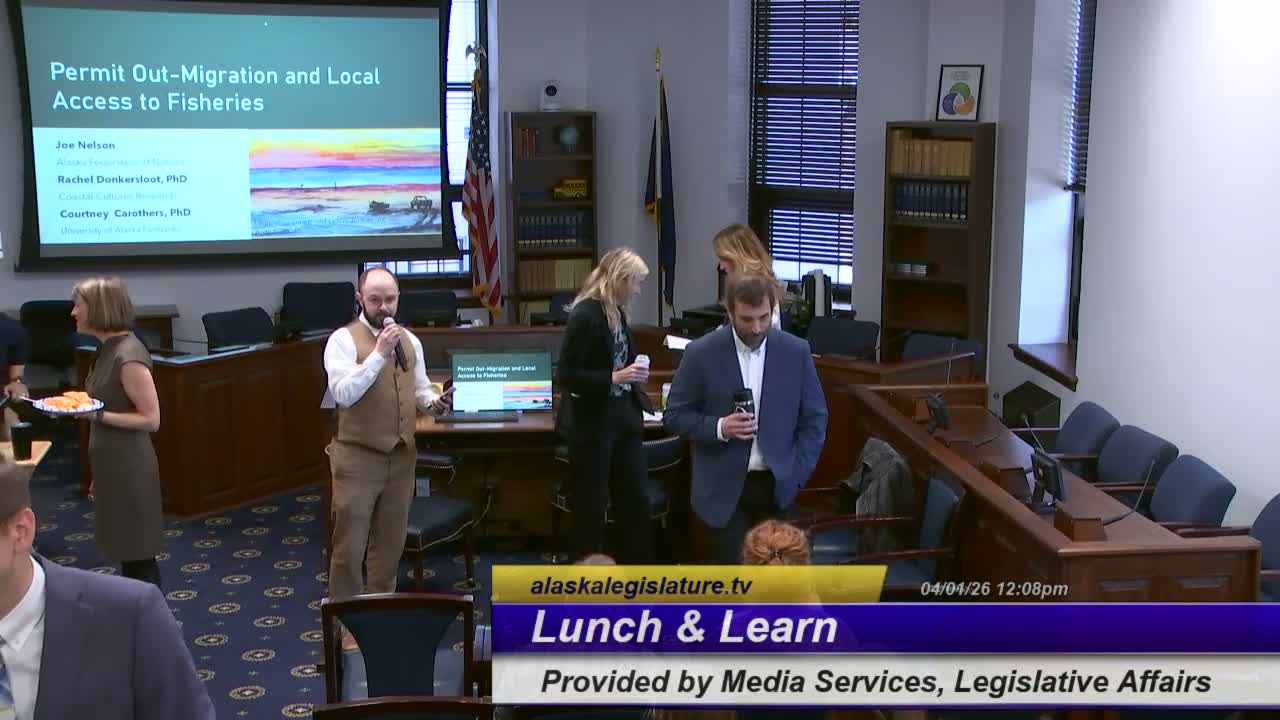
At a legislature lunch‑and‑learn, Alaska Federation of Natives cochair Joe Nelson and UAF researchers presented decades of data showing steady losses of local limited‑entry permits, large nonresident earnings leaving Alaska, and policy options including nontransferable permits, youth permits, and community‑held access to restore local fishing economies.
At a Capitol lunch‑and‑learn, Joe Nelson, cochair of the Alaska Federation of Natives, and University of Alaska researchers presented data showing decades of local permit loss under Alaska’s transferable limited‑entry system and outlined policy options to slow out‑migration and restore community access.
Nelson began by framing the issue as a statewide, nonpartisan concern and said the limited‑entry law “hasn't been significantly changed … in the 50 years.” He traced the program’s origins to a 1973 limited‑entry act and described how the point/dependency system and subsequent free transferability turned permits into high‑value commodities that priced many rural residents out of local fisheries.
Dr. Rachel Donkerslote, summarizing decades of scholarship and state reports, said studies dating to the 1970s and 1980s show a long‑term decline in Alaska Native and rural permit holdings and that the transferability feature raised barriers to entry. “Nonresident permit holders took back to their home communities $7,500,000,000 worth of salmon earnings” between 1975 and 2023, Donkerslote said, noting Bristol Bay accounts for about $3,900,000,000 of that total.
Dr. Courtney Carruthers presented village‑level survey results showing strong community concern: 98% of respondents said fishing is fundamental to traditional culture and village economies, 90% said their village future depends on access to fishing, more than 80% described local economies as in crisis, and only about 12% of survey respondents currently participate in fishing. Carruthers cited Metlakatla’s tribal fishery as an example where community control helped sustain local participation.
Presenters and audience members flagged several policy tools discussed in the literature and recent reports, including redesigning loan programs and buybacks, limiting transfer provisions, creating nontransferable or youth permits, and authorizing entities to hold permits in perpetuity for local use. Donkerslote described these options as a “menu of options” designed to be constitutional and targeted to local needs.
Audience members asked whether declining fish stocks drive permit departures; presenters emphasized that market forces have been dominant, with nonresident participation concentrated in highly lucrative fisheries such as Bristol Bay. Attendees also raised prior legislative efforts, including a regional fisheries trust proposal (previously discussed in HB 188), and asked how change could move through the Legislature; presenters said the matter is technically and politically complex and urged building a community‑centered approach.
The session closed with staff noting time constraints and encouraging continued discussion and staff research. Presenters made copies of the reports available and invited follow‑up dialogue.
Next steps: presenters encouraged technical study and policy design that centers community preferences and constitutional constraints; no formal motions or legislative actions were taken during the event.