University of Alaska tells House Finance it needs $60 million to halt growing deferred‑maintenance backlog
Loading...
Summary
University of Alaska President Pat Pitney told the House Finance Committee the system has roughly 400 buildings, an average building age above 37 years and a deferred‑maintenance backlog near $1.5 billion; the university’s top FY27 ask is $60 million to stabilize facilities, plus targeted capital and receipt‑authority requests for grant‑funded projects and housing.
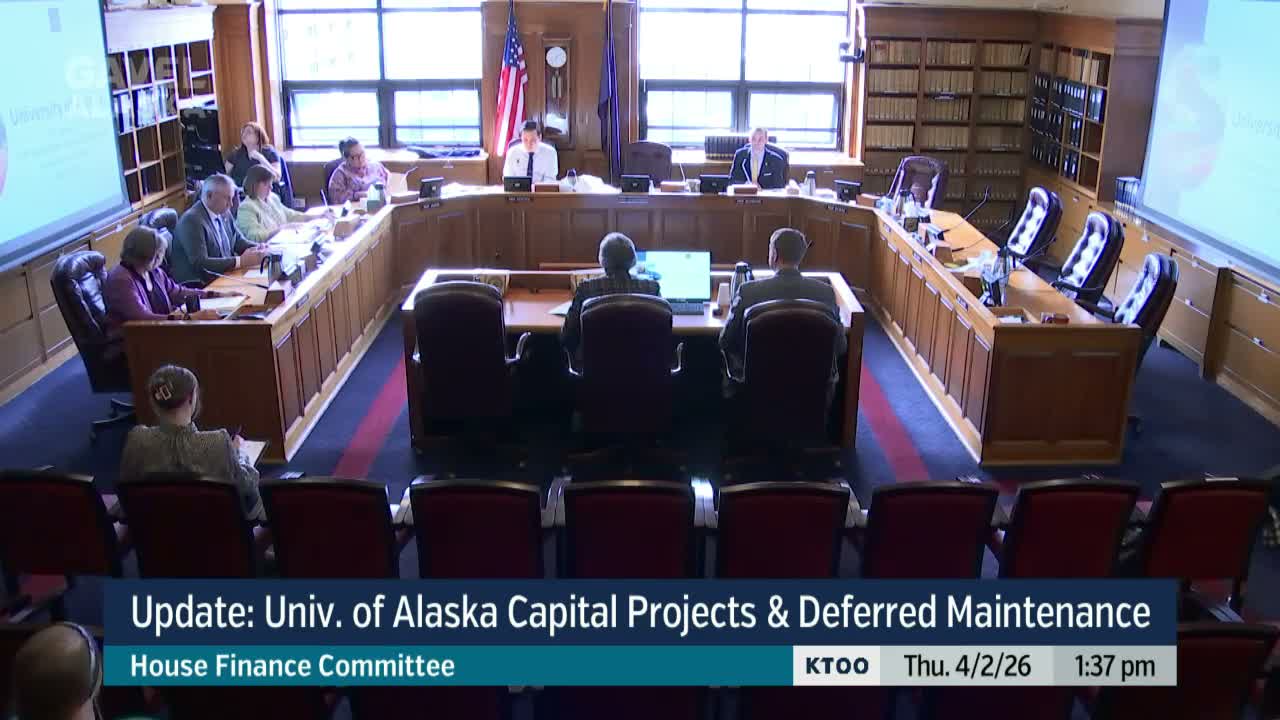
Pat Pitney, president of the University of Alaska, told the Alaska House Finance Committee on April 2 that the university system manages about 400 buildings with an average age exceeding 37 years and a deferred‑maintenance backlog “near 1,500,000,000.” She said the system spends between $26 million and $40 million annually from operating budgets and grants on upkeep but that to match depreciation the university would need more than $100 million a year. “The 60,000,000 that we consistently request is our top priority in deferred maintenance,” Pitney said.
Pitney and Chad Hutchinson, the university’s state director for government relations, described the FY27 capital package the university brought to the committee. In addition to the $60 million deferred‑maintenance request, the university seeks receipt authority to accept grant‑funded gifts and federal awards for several campus projects, including an Alaska Native gathering space and a Cyril George Indigenous Knowledge Center in Southeast. Hutchinson said some projects are eligible for grant funding but still require legislative receipt authority so the university can expend the funds.
Why it matters: committee members and university leaders said campus condition affects recruitment, retention and student success across Alaska. Several presenters tied facilities directly to workforce outcomes, noting that improved labs, housing and health‑service facilities make it more likely graduates will remain in the state.
Major project highlights and needs
- System scale and backlog: Pitney said the university system’s total footprint includes hundreds of academic, research, housing and lab facilities; she characterized the deferred‑maintenance backlog as a substantial, continuing liability that has grown because capital investment has not kept pace.
- Student housing: Pitney and Hutchinson outlined a housing concept that would rely on roughly a 60% state / 40% university financing split for two major projects (one at UAA and one at UAF). Hutchinson said that state support is critical because the university cannot recover the full debt service from student housing fees without pricing students out of attending.
- UAA — Cuddy Hall: Christopher McConnell, associate vice chancellor for facilities and campus services, described mechanical failures at Lucy Cuddy Hall (home to culinary and hospitality programs), including air‑handler issues, pipe failures and gas and ventilation systems sized too small for modern kitchen equipment; the failures forced closure of a campus café and interrupted donated equipment acceptance.
- UAF — Museum of the North: Cameron Wolford, UAF division of design and construction director, said a failed roof membrane and rotted underlying structure have exposed exhibits and collections to water intrusion. He described repeated emergency repairs and urged immediate roof replacement to avoid catastrophic loss to irreplaceable cultural and scientific artifacts.
- UAF — Cutler Apartments (student housing): Cameron Holford said several Cutler Apartment roof blocks are beyond lifespan; failures have caused mold and mid‑semester displacements. Holford described phased repairs already completed on three blocks, a request to address two more blocks now, and one remaining block as a future request. He said the proposed replacement uses an EPDM membrane with an expected 30‑year life and that retrofit constraints yield R‑values in the R‑40 to R‑45 range.
- UAA IT renewal and campus infrastructure: McConnell described a roughly $4 million IT backlog with a $1 million incremental ask to begin campus‑wide IT resilience work (data center, switches, campus connectivity and learning commons systems that support community campuses).
- Health, safety and accessibility projects: UAF described elevator modernization needs in the Irving building tied to fire alarm integration and life‑safety risks; engineering‑lab upgrades were framed as essential to maintain research continuity and address ventilation and fire‑safety deficiencies. UAS described seawater intake vulnerabilities in Juneau and HVAC control modernization in Sitka’s World War II hangar facility.
Questions and budget context
Committee members pressed presenters on whether student fees or housing reserves could cover repairs; presenters said those sources support some maintenance and life‑cycle reserves but are insufficient to fund large capital replacements because of rising construction costs and price sensitivity among students. Hutchinson provided FY25 figures, saying tuition/fees totaled roughly $111 million and unrestricted general funds were about $365 million, and he noted the university raised tuition 4% in November under Board of Regents authority.
What happens next
Committee members thanked university staff and directors for a concise presentation and asked for follow‑up on which FY27 requests appear in the governor’s capital or supplemental budgets. The committee took a brief at ease and returned to consider HB91. The presentation served as the university’s FY27 pitch to House Finance; any legislative funding action will require committee recommendation and appropriation during upcoming budget weeks.