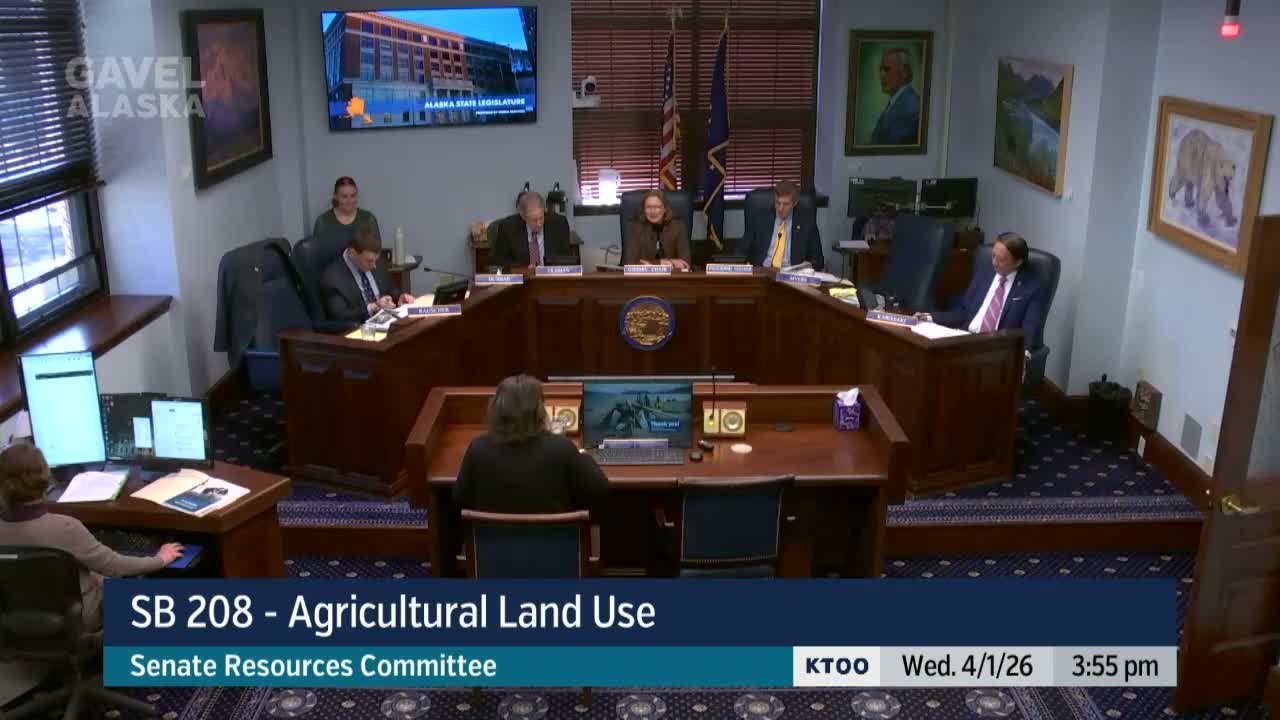
Committee hears bill to ease access to state agricultural land; farmers cite prohibitive appraisal fees
Loading...
Summary
Sponsor staff described a package that would create a merit‑based sale option, a new below‑market agricultural leasing program, and civil penalties to enforce covenants; farmers and farmland groups testified that appraisal‑driven fees can price producers out of state land.
Senate Bill 208, introduced by Senator Bjorkman and presented to the Senate Resources Committee by staff, would change how the Department of Natural Resources (DNR) offers state land for agricultural use.
Laura Ashi, staff to Senator Bjorkman, outlined the bill’s three primary components: an optional merit‑based sales process evaluated by criteria set in regulation; a new leasing program allowing applicants to identify a specific parcel and lease it with fees set by regulation and appraisals only when the commissioner deems them necessary; and authority for the Department of Natural Resources to assess civil penalties to encourage compliance with agricultural covenants. Ashi said the CS (version H) also includes lease renewal terms (including 10‑year terms), a preference to a lessee who has worked land for at least seven years, and an effective date that allows DNR to draft regulations immediately with substantive provisions effective January 1, 2027.
Committee members pressed staff on transferability, covenant enforcement and interactions with timber and other land‑use rules. Ashi said leases would be transferable with department approval; she described the merit‑based rubric as requiring applicants to provide farming plans and qualifications so that applicants intending only to harvest timber would likely fail the "best interest" test. Rachel Longacre, chief of operations for DNR’s Division of Mining, Land and Water, explained that DNR uses area plans and public processes to classify highest and best uses of state land and that agricultural covenants placed in deeds remain attached to the property through subsequent deeds.
Several invited witnesses representing farmers and farmland organizations described how current appraisal‑based fees can prevent productive agricultural use of state parcels. Emily Garrity (owner/operator, Twitter Creek Gardens, Homer) said her application for a 4.5‑acre parcel was later appraised at $117,000 and that the resulting annual lease fee would have been $9,360 — roughly $2,000 per acre — a price she called cost‑prohibitive for local food production: "Charging over $2,000 per acre per year for the land that [vegetables] are grown on is not gonna get us there." Garrity said SB 208 could remove that access barrier and allow her operation to expand local food production.
Amy Sites (policy director, Alaska Farm Bureau) supported the bill as a way to lower barriers to entry for farmers and help build secondary processing and support businesses. Margaret Adzitz (lands program coordinator, Alaska Farmland Trust) said the Trust has roughly 90 people actively looking for land and warned of farmland loss near population centers — noting that in one borough more than 3,000 acres of farmland were lost over the past decade — and urged tools to keep land productive and affordable.
Chair Giesel opened public testimony and, seeing no additional in‑room or online speakers, closed it and set the bill aside pending a future committee substitute from the sponsor.
What happens next: The committee set SB 208 aside while the sponsor continues stakeholder conversations and prepares an updated committee substitute; the record includes testimony and a request for regulatory detail and clarifications about timber, marijuana and definitions.