Testimony urges federal support for marine debris cleanup in Alaska
Loading...
Summary
Witnesses and nonprofits told the Senate Resources Committee that remote Alaskan shores are heavily affected by foreign‑sourced marine debris and urged the Legislature to back federal funding and logistics for backhaul and community‑led cleanups.
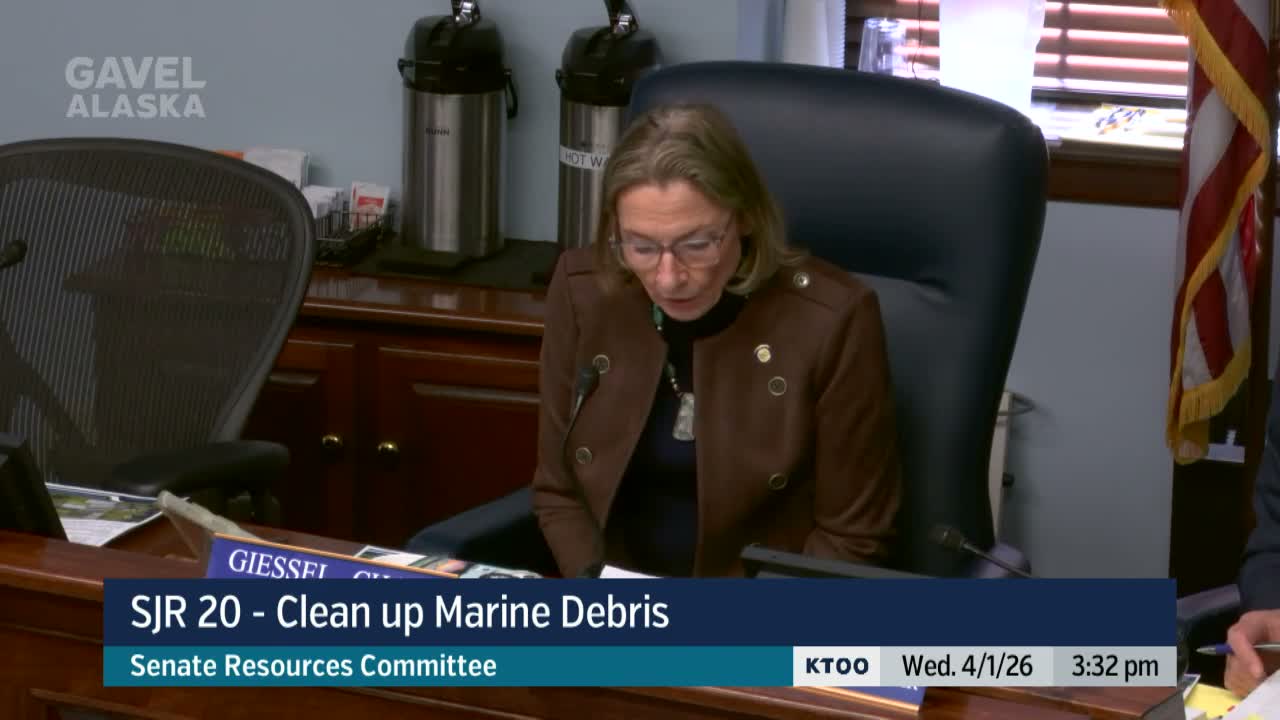
Chair Senator Giesel opened the committee and introduced Senate Joint Resolution 20, a first hearing urging support for coordinated marine debris cleanup across Alaska.
Sevea Bieber, staff to Senator Bjorkman, reintroduced the resolution and said it "supports efforts to clean up the shoreline around the state and urges federal agencies to provide funding for efforts to prevent cleanup and remove backhaul of marine debris." The resolution frames state support as a way to leverage federal resources and highlight local needs.
Michael Levine, senior director for Alaska at Ocean Conservancy, told the committee that debris on remote Alaska shores often originates from outside the state and that cleanup is logistically difficult. He said only about 6% of Alaska’s coastline has been cleaned since 2006 and noted the state’s roughly 44,000 miles of shoreline, much of it inaccessible by road. Levine described an Ocean Conservancy‑led marine debris backhaul pilot that helps communities move collected material to recycling or disposal facilities off‑island and said the group supports SJR 20 as a way to draw attention and federal resources to the problem.
Ginny Eckert, director of Alaska Sea Grant at the University of Alaska Fairbanks, described Sea Grant’s Alaska Center for Marine Debris and federal funding that supports community projects and innovations for converting collected plastic into usable products. She cited a federally funded $5,600,000 project that supports local grants and technical assistance and highlighted partnerships with commercial fishermen, tribes and local organizations.
Ralph Wolf, director of Indigenous Stewardship and the Tribal Guardians program at the Central Council of the Tlingit and Haida Indian Tribes of Alaska, described the local and cultural impacts: "For our tribal citizens, marine debris is a direct threat to our ways of life, food security and cultural continuity." Wolf asked the Legislature to prioritize cleanups that protect subsistence resources and salmon habitat and to invest in transportation, backhaul and community‑based workforce programs to sustain tribal‑led stewardship.
Committee members asked about international cooperation and legal frameworks; witnesses said existing partnerships have not been blocked by the United States’ non‑ratification of the Law of the Sea Treaty but that formal international regulation could affect standards and enforcement.
Chair Giesel opened public testimony, found none in‑room or online, closed public testimony, and set an amendment deadline for SJR 20 of 12:00 noon on Thursday, April 9.
What happens next: The committee set SJR 20 aside for amendment consideration; the resolution remains a first hearing and may be updated before further action.