Consultant says 6'cent alternative volumetric tax could improve AKLNG project's margins
Loading...
Summary
At an April 1 House Resources hearing, a Gaffney & Klein consultant said replacing Alaska's property tax regime for AKLNG with a 6'cent alternative volumetric payment (AVP) would expand the project's viability window; AGDC warned high property taxes could still put the pipeline 'out of the money. Lawmakers pressed for more modeling and set an amendment deadline for HB 381.
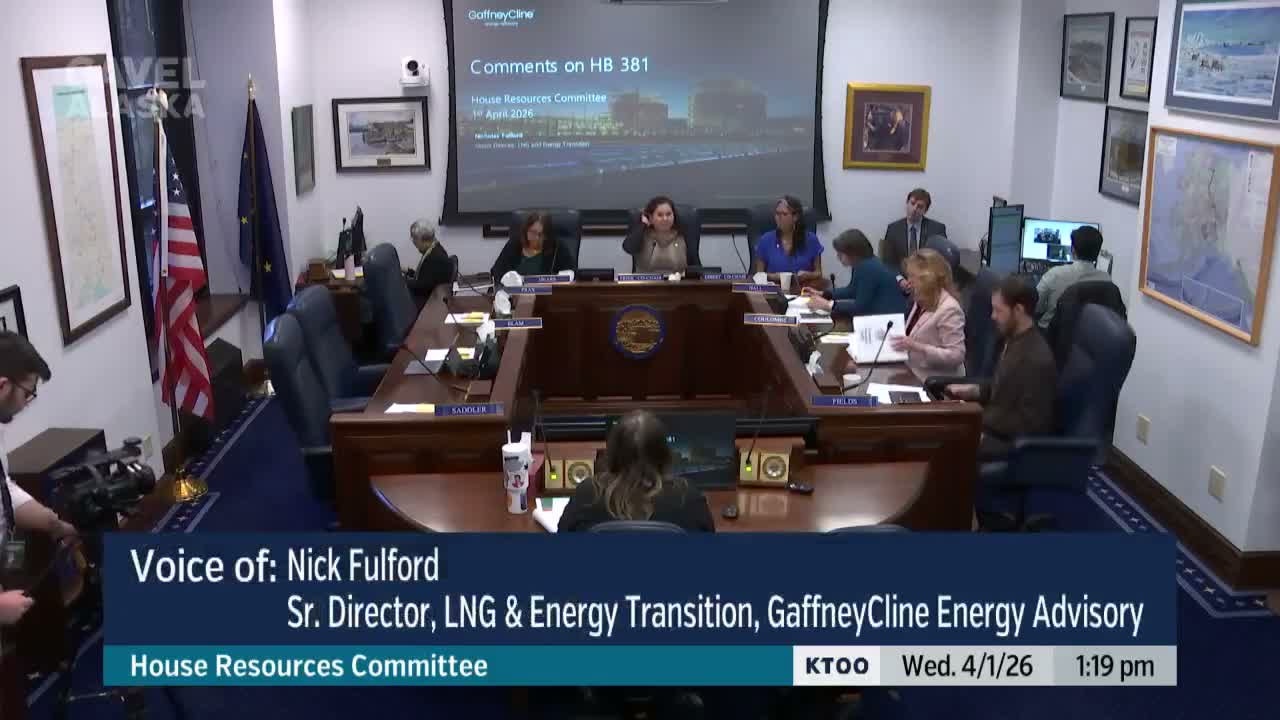
Nicholas Fulford, senior director of gas and LNG at consultancy Gaffney & Klein, told the House Resources Committee on April 1 that replacing Alaska's current property tax framework for the Alaska LNG project with a 6'cent-per-MCF alternative volumetric payment (AVP) would widen the project's zone of potential profitability and give lenders and buyers greater certainty. "The one feature of fiscal architecture that is not yet bottomed out is the property tax," Fulford said, arguing it's central to project negotiations.
Why it matters: Members repeatedly questioned how a change to property tax authority would affect borough revenues, the division of value among upstream producers and midstream developers, and whether the state could be leaving money on the table. AGDC's commercial director, Matt Kissinger, told the committee the company's modeling shows the project is competitive but narrow on returns: "this project's competitive, but it's skinny," he said, warning that a high property tax burden could make it difficult to attract investment.
Fulford framed the AVP as one of several fiscal tools that could be used to calibrate state and local take while still enabling a commercially bankable project. He reviewed international examples (including Tanzania, Mozambique and British Columbia), described common negotiation tools such as open-book economic models, and walked the committee through a DOR-derived sensitivity matrix that used a $47,000,000,000 baseline capital cost. Fulford said the AVP increases headroom for the project under multiple feed-gas price and cost-overrun scenarios.
Committee focus and outstanding questions: Lawmakers pressed Fulford and AGDC on several technical points: whether the slide checkboxes reflected Alaska specifically or a generic checklist; how AVP interacts with upstream tax or oil production tax deductions; whether an AVP should be progressive rather than a flat volumetric rate; and how state and borough revenues would be affected over time. Fulford said those tradeoffs are complex, that some capital allowances are reasonable given the magnitude of required slope investments, and that further modeling is appropriate.
Procedural outcome: Chair Co-Chair Freer set an amendment deadline for House Bill 381 of Friday, April 10, 2026, at 4:30 p.m., and set the bill aside for further review. The committee's next House Resources meeting was scheduled for April 8, 2026.
What remains unresolved: Committee members asked the Department of Revenue and AGDC to supply or validate modeling on municipal revenue impacts, royalty projections and alternative tax permutations. Multiple legislators said they want transparent, open models and additional analysis of how any property-tax change would interact with broader oil-and-gas tax policy.
The committee adjourned after the procedural announcements; no formal vote on HB 381 was taken at the April 1 hearing.