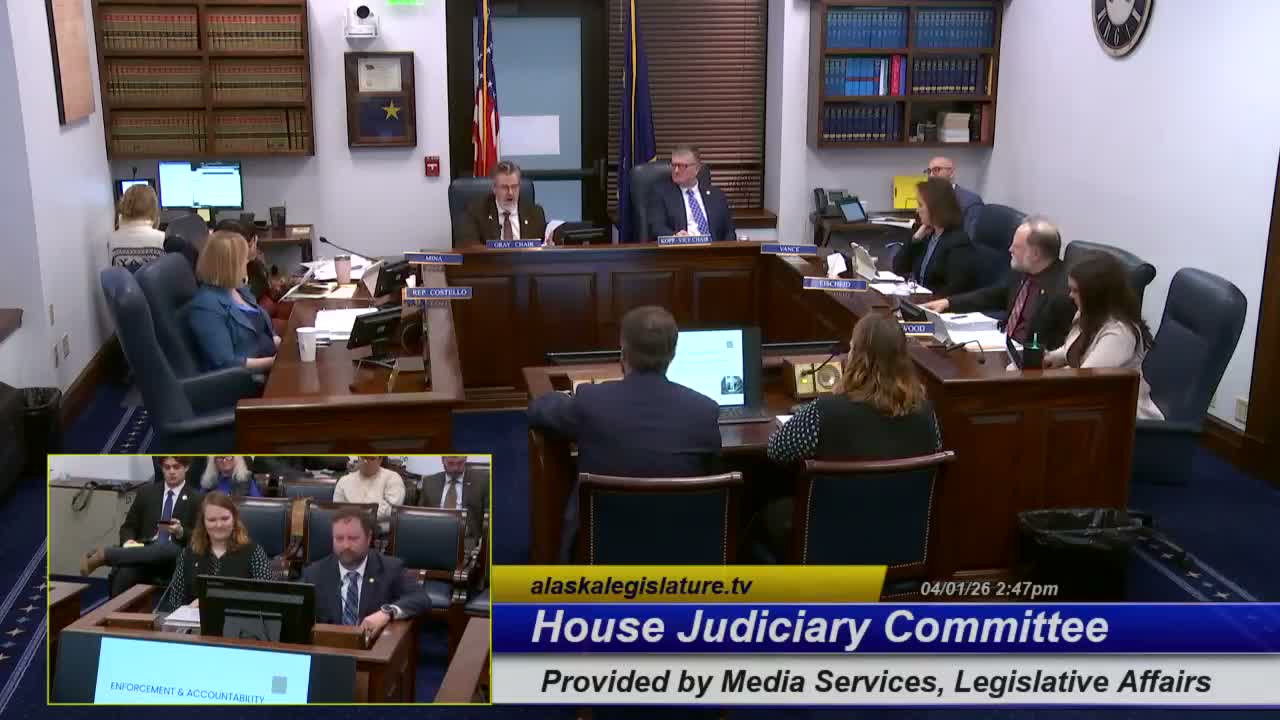
Committee debates confidential birth, baby boxes and alternatives in infant‑surrender bill
Loading...
Summary
Lawmakers and invited experts debated the committee substitute to HB 64, which adds confidential birth options, delivery under an assumed name, and requirements for health‑department materials. Witnesses warned of risks and costs tied to baby boxes and urged public education, paramedic handovers and stronger support services.
Juneau — The House Judiciary Committee on April 1 considered a committee substitute to HB 64, a bill that would expand safe‑surrender options by allowing confidential labor and delivery services, removing a birthing person's name from the birth certificate when surrendering under existing law, and directing the Department of Health to publish materials about confidential birth.
Dylan Hitchcock Lopez, the committee aide, outlined four substantive additions in the substitute: confidential labor and delivery under an assumed name; a subsection to keep a confidential birthing person's name off a birth certificate when surrendering under safe‑surrender law; explicit inclusion of confidential birth in statutes governing examination and treatment of minors; and Department of Health duties to publish information and develop informational materials.
Invited experts gave mixed testimony. Laurie Bruce, a research scientist who has studied safe‑haven policies, cautioned that baby boxes and some anonymous surrender models have not demonstrably reduced unsafe abandonments in several country case studies and raised concerns about reduced opportunity for counseling and clinical assessment when surrender is mechanical. "Boxes can decrease informed consent and clinical contact for the mother," Bruce said, and urged careful education and oversight.
Noel Osmic, former director of research and development for the National Safe Haven Alliance, said anonymous‑birth options and hospital practices that protect identity could make care more accessible to people who fear discovery and cited hospital-based alternatives (back entrances, parking‑lot handovers, patient alias procedures). Dr. Anne Zink, an emergency medicine physician and former state chief medical officer, warned of costs and operational burdens of manufactured baby boxes (citing roughly $20,000 per unit and ongoing fees), and emphasized that minutes matter for fragile newborns and that an in‑person handover permits immediate medical assessment.
Senator Robert Myers, sponsor of a companion bill in the Senate, emphasized tragic recent infant abandonment cases in Anchorage and described the legislation as providing an option to keep babies from being left in unsafe places. Several lawmakers suggested combining public education about existing safe‑surrender options (including calling 911) with any changes the committee forwards.
Committee members discussed possible alternatives and safeguards — tighter procurement language to avoid vendor lock‑in, inspection and maintenance schedules, provisions to publicize anonymous options and clarifying language to address constitutional and confidentiality concerns. The committee left the substitute on the table and set HB 64 aside for further consideration; no final vote was taken at the April 1 hearing.