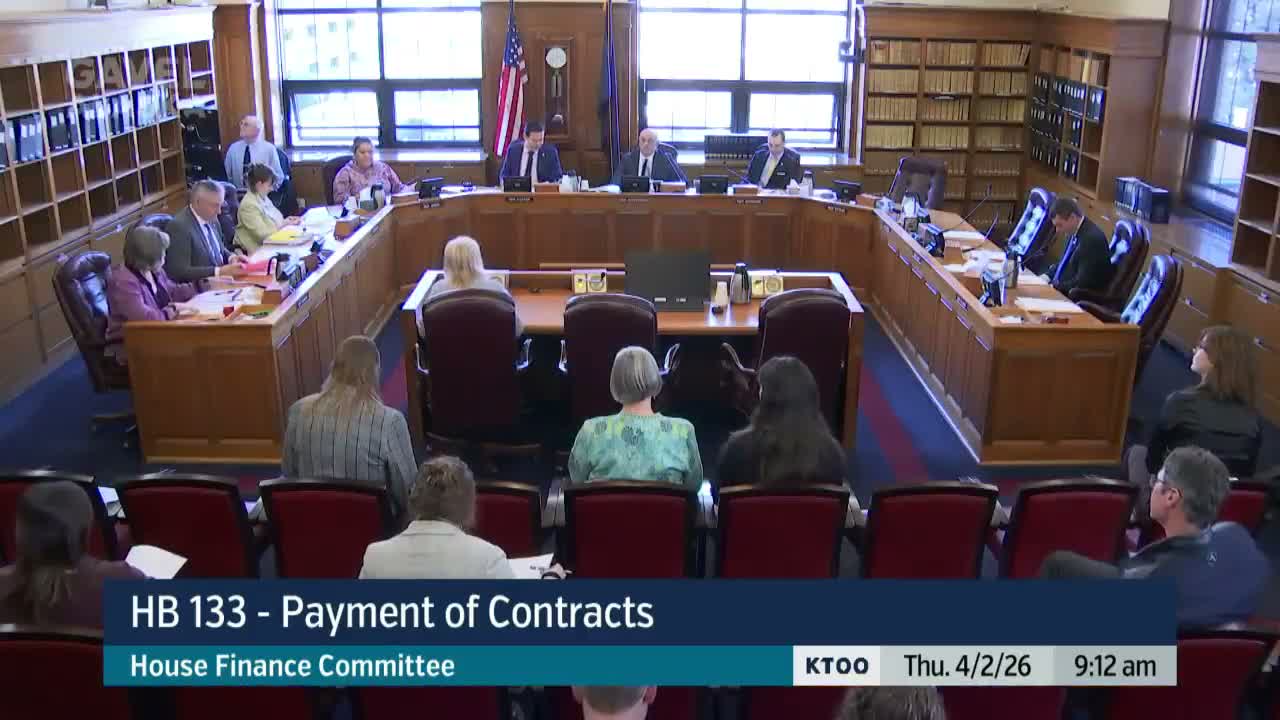
Witnesses tell House Finance late state payments threaten nonprofits and transit providers
Loading...
Summary
Public testimony at the House Finance Committee urged lawmakers to pass HB 133, a bill requiring state payment of contractors and grantees within 30 days; nonprofit leaders and transit officials described lost revenue, lines of credit and service risk from chronic reimbursement delays.
Representative Rachel Hemschute opened public testimony on House Bill 133, telling the committee the bill would set a 30‑day payment timeline for nonprofits, municipalities and tribal entities and make the state a more reliable business partner.
Brenda Stanfield, executive director of the Alaska Network on Domestic Violence and ****** Assault, told the committee delayed payments forced her former nonprofit to open a line of credit to make payroll after reserves were exhausted. “When I had still received no payments in September and exhausted all of my reserves, I was forced to set up a line of credit to make the payroll,” she said, and urged members to “support and pass HB 133.”
Other testifiers described similar harms. A private sector IT firm executive said an agency was five months late on payments; he noted that 80% of his costs are staffing and that long payment delays make it difficult to meet payroll. Pat Branson, a retired nonprofit CEO involved in Kodiak transit, said grant amendments tied up reimbursements until months into the fiscal year; Ketchikan transit director Kyan Reeve said delays have stalled capital projects and that the state provides no matching funds for rural transit, leaving local providers to front costs.
Representatives used testimony to press executive branch presenters on fiscal assumptions. Pam Halloran, assistant commissioner for the Department of Health, described a methodology that compared the value of interest penalties (as written in HB 133) to the cost of hiring accounting positions; for several divisions the department estimated it would cost less in the short term to pay penalties than to fund new positions. Halloran said the fiscal notes were built from FY25 data and that shared‑services staff returning to agencies would require training and not immediately eliminate backlogs.
Committee members pressed agencies for vacancy counts and asked for follow‑up details on grant‑specific timelines; Halloran agreed to provide additional data. The committee set an amendment deadline of April 8 for HB 133 and signaled willingness to consider transition language to give agencies time to comply.
The committee closed public testimony on HB 133 after hearing from providers across sectors and proceeded to a detailed fiscal‑note review.