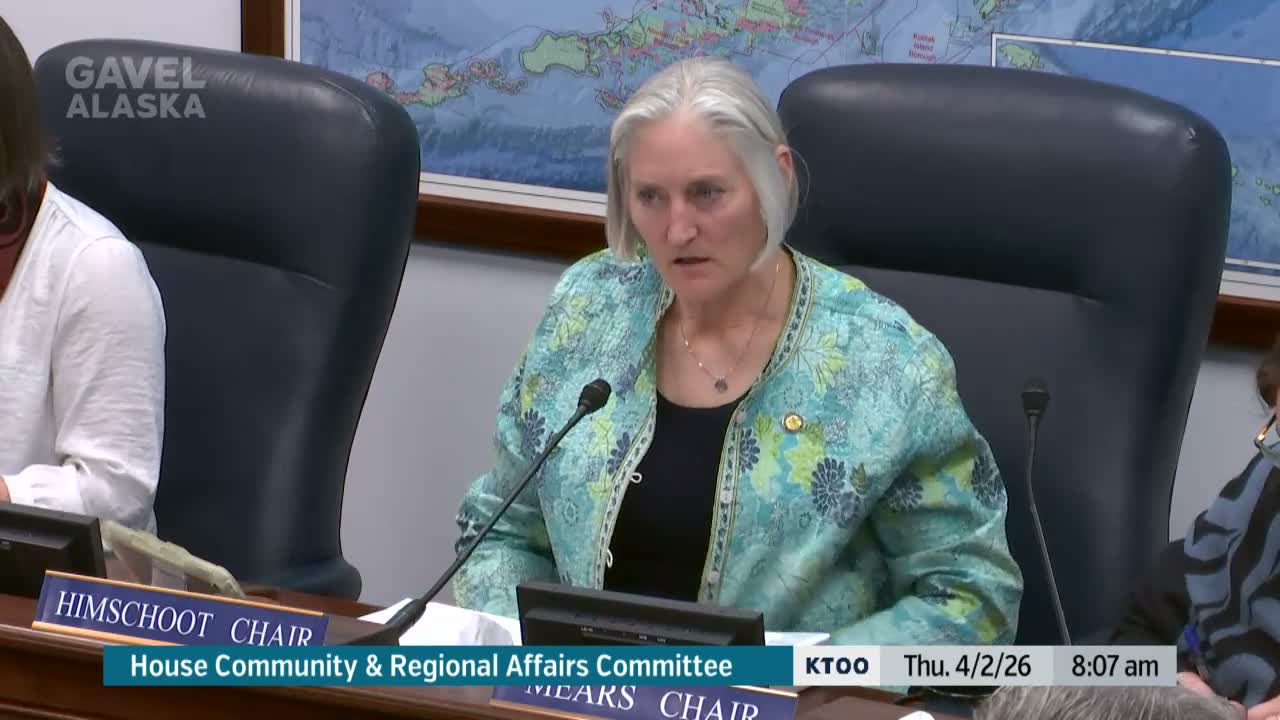
House panel hears bill to recognize emergency dispatchers as first responders
Loading...
Summary
Sponsor Rep. Carolyn Hall told the committee HB 234 would amend Alaska statutes to classify emergency dispatchers as first responders, potentially opening eligibility for federal grants and state public‑safety retirement benefits; law‑enforcement witnesses from Sitka, Unalaska and Kotzebue urged passage to help recruitment and retention.
Rep. Carolyn Hall (House District 16) asked the House Community and Regional Affairs Committee to advance House Bill 234 to amend the definition of emergency medical dispatchers so the statute explicitly recognizes them as first responders.
"To review, HB 234 does two things," Hall said, describing the change that would clarify dispatchers’ status and allow dispatch centers to pursue additional federal grants and training opportunities.
Why it matters: supporters told lawmakers that dispatchers in Alaska—especially in small and remote communities—routinely provide life‑saving instructions, triage calls and coordinate responses when field units are hours or days away. Reclassification would also let some dispatch centers access funding and put dispatch personnel in the same retirement classification as police and firefighters, sponsors said.
"Because we are often the first public safety professionals in contact with people during an emergency, dispatchers are often referred to as the first responders," said Peter Gurney, Communications Sergeant, Unalaska Department of Public Safety, describing dispatchers’ certification in emergency medical, fire and police dispatch protocols.
Lieutenant Shauna Shay (on the record) described dispatching’s evolution: training and technology have expanded the role from simply forwarding calls to triaging, giving CPR and medical instructions, and coordinating multi‑agency responses. Christopher Cook, police chief in Kotzebue, said the work’s stress and irregular hours make recruitment and retention difficult and argued that recognition would help.
Committee members probed rural implications and the potential for added job requirements. Representative Kai Holland asked whether formal recognition could change the role’s scope as telemedicine and other remote supports increase; Rep. Hall and witnesses said the bill is intended to provide recognition and access to benefits and grants, not to alter day‑to‑day duties.
The committee also discussed related federal bills: witnesses and staff referenced the Enhancing First Responder Act and the 9‑1‑1 Saves Act as complementary federal efforts that could expand grant access if state classification aligns.
Public testimony came from Matthew Carlson, a firefighter‑paramedic, who said the federal reclassification would move dispatchers toward a protective services class but that a state change into public safety status could unlock a broader set of FEMA and other federal grants.
Next steps: the committee set HB 234 aside for further consideration and established an amendment deadline of Friday, April 3 at 5:00 p.m.
The committee did not take a final vote on HB 234 during this meeting.