Get Full Government Meeting Transcripts, Videos, & Alerts Forever!
Get email alerts on the Water Infrastructure topic
No spam. Unsubscribe anytime.
Fort Smith engineers warn of looming water supply limits; board weighs leak detection, meter replacement and phased transmission upgrades
Summary
City engineers told the board the water system faces capacity and reliability risks: nonrevenue/unaccounted-for water rose to about 36% in 2025, transmission and treatment upgrades could cost in the hundreds of millions, and staff recommended satellite/drone leak detection and phased meter replacements as lower-cost ways to buy time.
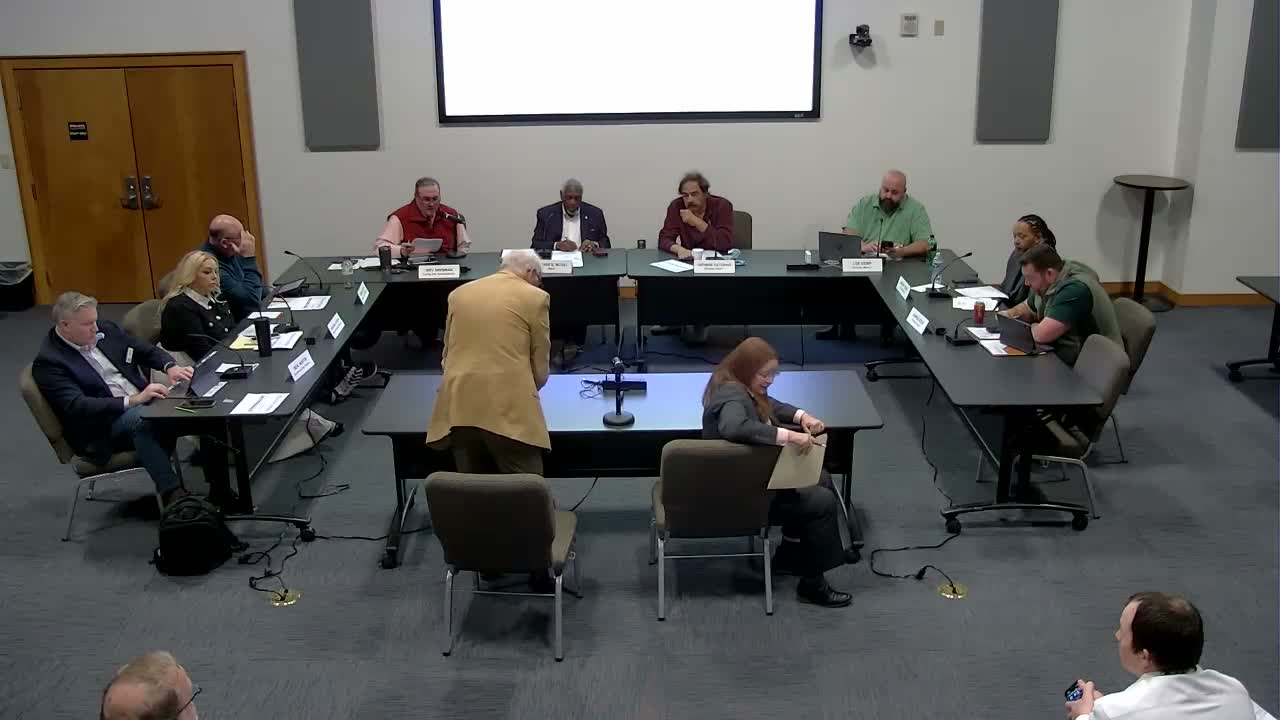
City engineers and consultants presented Fort Smith—s water system master plan and a set of options to address capacity, leaks and aging infrastructure at the Feb. 10 study session, warning that the system could reach its treatment/transmission limits within years unless the board acts.
Todd Mitke, the director of engineering, summarized the system: roughly 719 miles of pipe, two treatment plants (Lake Fort Smith plant ~40 million gallons per day capacity; Lee Creek ~10 million), 13 storage tanks, and a five-phase transmission-line improvement with a remaining project scope of about 35 miles. He said the 2022 master plan projects maximum daily demand could exceed current combined treatment/transmission capacity in the late 2020s without upgrades.
Mitke and Hawkins Weir consultant Wes presented demand projections and hydraulic modeling. They reported a peak maximum daily demand near 47.7 MGD in 2024 and projections that, under a 1.5% growth assumption, the system would approach the 50 MGD treatment-transmission threshold by 2027—28. Mitke noted the board could consider a lower growth assumption (1.14%) aligned to nine-year trends and asked for direction on growth-rate assumptions for revised slides.
Unaccounted-for water and meters dominated much of the discussion. Staff reported an estimated 25% nonrevenue water in the 2022 plan, but utility data showed unaccounted-for water around 36% for 2025. Public-works staff said crews fixed roughly 90% of previously identified leaks between September 2025 and the present but that remaining losses are harder to find. Todd Mitke and other staff recommended satellite or aerial infrared leak detection as a targeted project to identify otherwise invisible leaks, with a likely price range of $60,000—50,000 depending on coverage.
Meter testing and replacement also drew sustained attention. Operations staff said roughly 40,000 meters are in the field and the city can replace about 10,000 per year in-house if funding is available. A phased AMR/AMI program was estimated in previous materials at $25M—5M for a full AMI rollout; staff proposed a lower-cost multi-year AMR replacement of roughly $2.6M per year (about $260 per meter installed) as a feasible four-year program to materially reduce billing and unaccounted-for water.
On large capital work, Mitke and consultants estimated transmission-line and treatment-plant upgrades to be in the hundreds of millions of dollars; one presenter cited roughly $200 million for transmission and another $130—70 million for treatment-plant expansions to reach 70 MGD. Directors debated funding options including grants, federal appropriations, phased CIP budgeting, rate adjustments, and regional cost-sharing given that Fort Smith supplies wholesale customers outside the city. Several directors urged breaking projects into smaller, prioritized phases and asked staff to return with clearer funding options and revised demand projections.
Directives from the board included: provide the updated Hawkins Weir slides reflecting a 1.14% growth assumption, return a clear breakdown of carryover/carryforward items tied to active obligations, provide pricing and implementation options for satellite leak detection and for meter replacement programs, and produce phased CIP alternatives showing priority projects and potential regional cost-share.