Get Full Government Meeting Transcripts, Videos, & Alerts Forever!
Get email alerts on the Parks topic
No spam. Unsubscribe anytime.
Lacey Rock tells Seaside commission dense neighborhoods lack nearby parks, outlines planning-grant approach
Summary
Resident and presenter Lacey Rock told the Seaside Environmental Commission that Terrace West/East and Olympia neighborhoods are more than a half-mile from a park and urged planning and grant work to create small, feasible park sites; she recommended community surveys and partnership-based planning.
At a meeting of the Seaside Environmental Commission, presenter Lacey Rock described gaps in park access across Seaside and urged the commission to pursue planning studies and targeted grant funding to create accessible green spaces in dense neighborhoods.
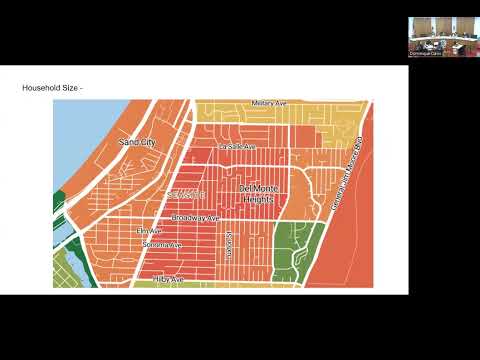
Rock said neighborhoods she calls Terrace West, Terrace East and Olympia are “more than a half mile away from a park,” and noted those areas have higher population density, larger numbers of children and greater nonwhite populations. “For a lot of people, especially in denser areas of a city, a tree in their backyard might be their first and only interaction with nature,” Rock said, arguing that small, nearby parks can provide physical, mental and community benefits.
Rock summarized prior planning and grant work: she prepared a planning grant application on behalf of Communities for Sustainable Modern Economy and gathered letters of support from the City of Seaside, Big Sur Land Trust, Community Partnership for Youth, County Business Council, California Green Business Network and the Seaside Parks Association. She said the application was intended as an early-stage planning or prefeasibility effort rather than a construction grant.
“Once you have that [grant-writing] down, you can sort of pull and use that for future opportunities,” Rock said, describing the grant as a tool to identify the most feasible open spaces and the outreach needed before pursuing hardscape design or construction.
Commissioners asked whether candidate parcels were publicly owned and how the project would proceed if sites were private. Rock acknowledged many candidate sites are privately owned and recommended a deeper analysis of public versus private options, community surveys to confirm priorities, and outreach to organizations experienced with similar projects. She cited the Broadway project and examples of alleyway parklets as models that changed commercial corridors and encouraged community pride.
Rock recommended partnering with organizations experienced in neighborhood park projects; commissioners and staff suggested consulting the city’s economic development inventory of city-owned parcels as a next step. The presentation closed with a request for follow-up research and community outreach if the commission wants to include park-equity work in its annual plan.
The commission did not take a formal vote on Rock’s recommendations; staff and commissioners agreed to consider the work as a candidate item for the annual work plan and possible future grant applications.