Get Full Government Meeting Transcripts, Videos, & Alerts Forever!
Get email alerts on the Personnel Evaluation topic
No spam. Unsubscribe anytime.
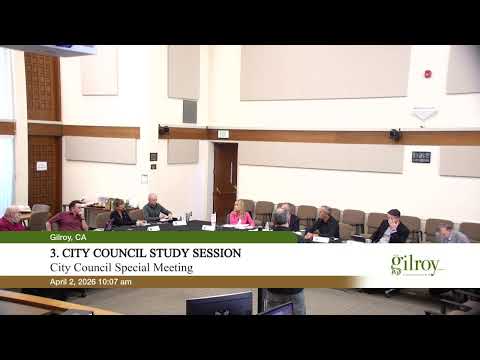
Gilroy council adopts 1–10 scoring, agrees on 50/50 weighting for city administrator evaluation; asks Matt to draft milestones
Summary
At a study session April 2, the Gilroy City Council agreed to rate the city administrator on ten items using a 1–10 scale (total 100 points), with the council majority favoring equal weighting between five qualitative measures and five special initiatives; the administrator was asked to return with specific milestones and a proposed performance-pay matrix for formal action.
City Administrator Matt (last name not provided in the transcript) and the Gilroy City Council spent most of a study session April 2 crafting a performance-evaluation approach that combines five qualitative performance categories and five council-selected special initiatives.
The council, after extended discussion, agreed to a uniform 1–10 rating on each of the 10 criteria so that a perfect score would be 100 points. A majority of members favored applying equal weighting to the two parts (50 points qualitative, 50 points special initiatives), a compromise intended to balance subjective judgments of management and leadership with measurable, time‑sensitive outcomes tied to the council’s legislative priorities.
The session began with a consultant-style presenter outlining two evaluation components: individual/professional characteristics, organizational management and policy delivery, relations with the council, fiscal management and community relations (the qualitative side), and a set of five special initiatives drawn from the council's recently adopted legislative agenda. Council members debated how much emphasis to place on long-term institutional strategy versus short-term, objective milestones. One member argued that “outcomes matter” and favored a stronger tilt toward the special initiatives, while others warned that too much weighting on initiatives could be short-sighted if priorities or council membership change.
Matt told the council he sees the two lists as interrelated and asked the council to consider transition planning — noting the next evaluation period will overlap with potential changes in council membership — when the body sets milestones and weights. The council asked Matt to return with specific, three-part milestones for each special initiative and said it would work with a contracted facilitator to run the formal evaluation process next year. The facilitator was described as a standard part of the process: to gather one-on-one input, check for bias and present synthesized findings in closed session before any formal action.
Members also reviewed a draft performance-pay matrix linked to evaluation scores and discussed the public-perception implications of incentive pay. During the meeting one participant referenced a figure of $4,040,000 in the context of compensation discussions; councilors described that as part of earlier negotiation talks and not as an adopted number. The presenter and staff emphasized any bonus structure ultimately would need open-session approval and likely an amendment to the administrator’s employment contract.
The council endorsed scheduling a short follow-up study session and directed Matt to draft milestone language and the numeric matrix for council review. There were no public speakers during the meeting; the council adjourned after confirming next steps.
The next procedural steps the council identified are: Matt will prepare milestone definitions for the five special initiatives and proposed dollar-matrix adjustments for review; council staff will scope facilitator options; and the council will return in study session and then take any compensation or contract changes to open session for formal adoption.