Get Full Government Meeting Transcripts, Videos, & Alerts Forever!
Get email alerts on the Barton Springs Bridge topic
No spam. Unsubscribe anytime.
Preservation groups urge fuller review as city advances Barton Springs Bridge replacement
Summary
City engineers say the Barton Springs Bridge is functionally obsolete and replacement was directed by Council; preservation groups and local historians argued the city has not fully explored rehabilitation or alternatives and pointed to Section 106 and DOT Section 4(f) requirements. Staff said NEPA is underway and THC coordination is in progress.
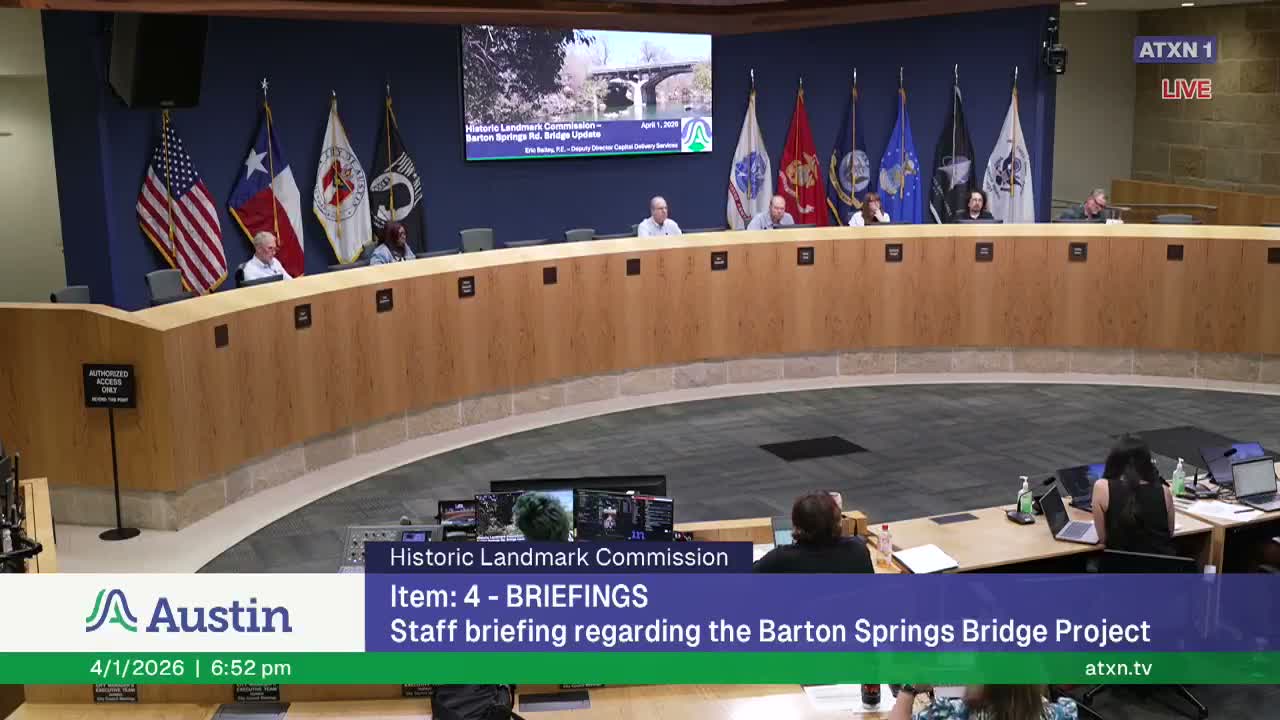
City staff told the Historic Landmark Commission that the nearly 100‑year Barton Springs Bridge is functionally obsolete because of extensive deterioration to the deck and spandrel columns, and that the bridge’s condition makes a ‘‘light touch’’ rehabilitation impractical.
"There is no way to have a light touch rehabilitation on this structure," Eric Bailey, deputy director of Capital Delivery Services, said while describing consultant engineering findings that the deck needs replacement and that some spandrel columns exhibit spalling and low compressive strength.
Because the project is pursuing a $32 million Federal Highway Administration Bridge Improvement Program construction grant, staff said the work must go through the National Environmental Policy Act (NEPA) process with TxDOT as the administering agency and in coordination with the Texas Historical Commission (THC) and U.S. Army Corps of Engineers. Bailey said the NEPA study will take roughly a year and the team expects to be ready to bid in early 2027.
Preservation advocates told the commission they believe the city’s outreach and review have been insufficient and pressed for a more rigorous alternatives analysis under federal law. "This project seeks to demolish a National Register‑listed bridge despite a limited public engagement process and irregularities in the city's review of historic structures," Megan (Meghan) King Namor of Preservation Austin told commissioners, citing Section 106 of the National Historic Preservation Act and Section 4(f) of the Department of Transportation Act.
Restoration architect Tara O'Connell (Save Our Springs Alliance) and architectural historian Laurie Martin urged landmark designation; Bill Bunch (executive director, Save Our Springs Alliance) disputed staff cost comparisons and argued that preservation alternatives—such as a parallel pedestrian span—were not adequately studied. "Our own reengineering reports show that we can in fact save this bridge for less money at this point than to tear it down and replace it," Bunch said.
Commissioners asked technical questions about inspection ratings, load restrictions and whether the bridge could be retained for pedestrians while a new vehicular span is built alongside it. Staff said earlier council direction from the 2020 bond program favored replacement, that the THC has been consulted about whether full replacement is a viable alternative, and that final determinations are part of the NEPA and permitting process.
Next steps: staff said the 90% design submittal is due from the consultant this month, which often triggers permitting, and the NEPA process will define notice, comment periods and formal coordination with the THC. Staff committed to returning with more technical detail in response to commissioner questions.
Why it matters: Barton Springs Bridge is a contributing feature to the Zilker Park National Register historic district; whether and how the bridge is altered has design, cultural and legal implications for the park and for compliance with federal historic‑preservation requirements.