Get Full Government Meeting Transcripts, Videos, & Alerts Forever!
Get email alerts on the Data Centers Policy topic
No spam. Unsubscribe anytime.
Austin Environmental Commission urges council to adopt strict controls on data centers, including moratorium in city limits and ETJ
Summary
The commission voted unanimously to send a package of policy recommendations to City Council addressing data‑center energy and water use — urging regional coordination, minimum on‑site renewables for Tier‑2+ facilities, reclaimed water for cooling, a 75% rooftop solar target, mandatory curtailment during declared electrical emergencies and a moratorium on new data centers inside Austin and its ETJ.
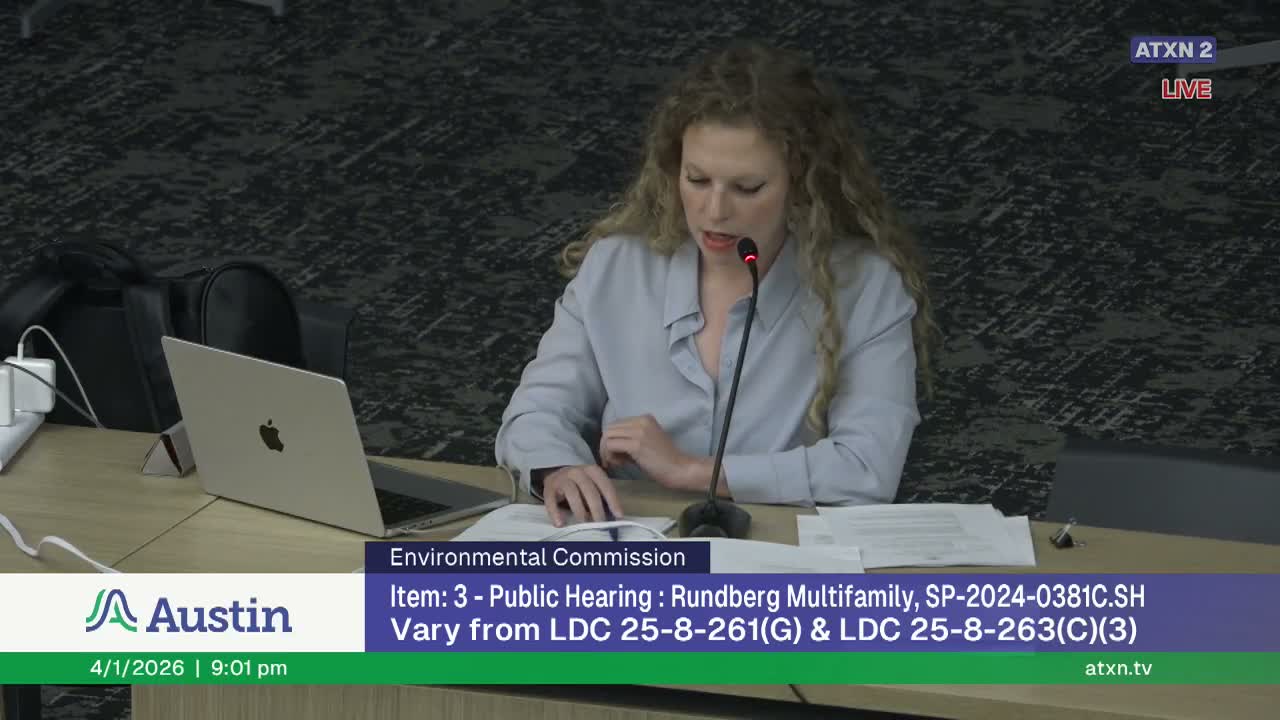
The Austin Environmental Commission on April 1 unanimously approved a broad set of policy recommendations for City Council intended to limit the environmental footprint of hyperscale data centers and to preserve regional water and energy resources.
Commissioners described rapid growth in large data‑center development locally and statewide and said the commission needed to act to protect water supplies, reduce greenhouse‑gas risk and manage grid impacts. Commissioner Sullivan framed the item with national and local data on the sector’s rapid expansion and rising electricity demand; he warned that new AI‑driven facilities can consume power and water at scales that meaningfully affect regional supply.
The adopted package asks City Council to pursue multiple actions: coordinate policies with neighboring counties, cities and water districts; publish and present the city manager’s ten‑year environmental impact and resource‑use report to the commission; require Tier‑2 and higher data centers to generate at least 50 percent of operating power on‑site from renewables (including solar, wind and battery storage); mandate curtailment of data‑center operations during declared electrical emergencies; require council approval for large‑scale water or service extensions; adopt a local code definition for 'data center'; require 75 percent rooftop solar coverage where practical; mandate reclaimed water (and direct investment into Austin’s purple‑pipe program); require bird‑friendly and night‑sky compliance; and prohibit local tax breaks that incentivize siting of new data centers inside Austin.
Public commenters and commissioners emphasized water as the most pressing local constraint. Bobby Levinsky, an attorney with Safer Springs Alliance, urged adding water districts to regional coordination, requiring council approval for large service‑extension requests, and considering bans on potable water use for cooling towers. "We have to put up obstacles at every point because we can't handle what's coming to us," Levinsky said.
Commissioners also debated complementary policies: noise controls, public notice within one mile of large data‑center construction sites, and leveraging tax policy to discourage new facilities. Vice Chair Krueger argued for bold measures, saying "No new data centers, period," as an alignment with national moratorium calls; the approved text included language aligning with bipartisan national calls for a moratorium on new centers in Austin city limits and the ETJ.
The commission voted unanimously to approve the resolution and forward it to City Council for consideration; commissioners asked staff to coordinate transmission and to present the city manager’s report and annual updates to the commission going forward.