Get Full Government Meeting Transcripts, Videos, & Alerts Forever!
Get email alerts on the Public Safety Emergency Response topic
No spam. Unsubscribe anytime.
Residents press county on evacuation, language access and proprietary modeling after Moss Landing fire
Summary
During a Monterey County public kickoff, residents described delayed evacuation orders, sheltering problems and model transparency gaps from the January Moss Landing incident, and urged county requirements for exercised emergency plans, reproducible plume modeling and equipment inspection. County staff committed to stronger guidance and technical review.
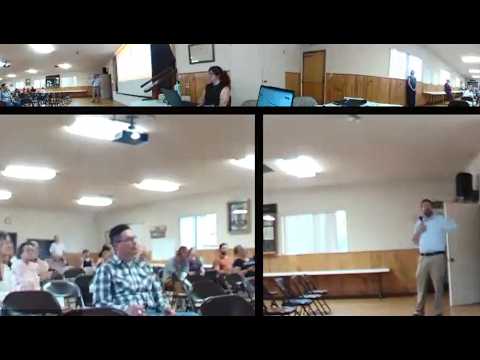
Residents and county staff used a public kickoff meeting on April 4, 2026, to air continuing concerns about the January battery‑storage incident at Moss Landing, focusing on evacuation timing, language access and the limits of proprietary modeling.
At the meeting, a resident asked about the timing of evacuation orders. An agency official responded: "The evacuation orders were issued by the sheriff, about 3 hours after the incident began." The official explained initial health alerts were sent to a limited area because modeling and air‑monitoring data were not yet available, and that orders were expanded as monitoring improved.
Several attendees said Spanish‑speaking residents were not effectively reached during the incident and that some evacuees went to the Castroville Recreation Center, which attendees said lacked heating. County staff clarified that the Castroville Rec Center is operated by the Castroville Recreation & Park District (not the county) and said the county is working with the district to identify funds for electrical upgrades; staff also pledged to follow up on whether Spanish‑language alerts were received by intended recipients.
Residents and staff criticized the quality and transparency of operator modeling and post‑incident analyses. Staff said some operator modeling was proprietary and difficult to interpret in an emergency, and noted instances where models did not reflect smoke observed on the ground. An example cited by staff: a federal (IMAX) flow model used during the incident did not include the smoke plume, and staff called for multi‑scenario plume simulations covering incremental fractions of the battery inventory (examples cited at the meeting: 5%, 10%, 25%, 50%).
Attendees pressed the county to require that emergency action plans be exercised, not only modeled. The agency official said SB 38 does not require plans to be exercised and that staff find that shortcoming unacceptable; the county will ask operators to test their emergency plans and provide regular training schedules and verified exercises.
Meeting participants also raised equipment and inspection concerns. A speaker said the California Fire Marshal’s committee found a high failure rate among alarm systems for large energy facilities; meeting participants urged the county to require certification and pre‑operational inspection standards before facilities go online.
County staff said they will incorporate these concerns into the guidance and draft ordinance, and noted that some developers may elect California Energy Commission review for very large projects (CEC review includes its own public and environmental review), while most local projects will remain subject to county zoning and permitting rules. No formal action or vote was taken at the meeting; staff said draft regulations will be released for public comment after formation of a steering committee and securing a consultant.