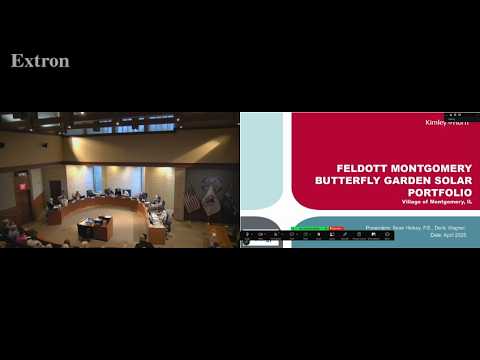
Commission backs Feldet Butterfly Garden solar plan with conditions after neighbors raise tile and screening concerns
Loading...
Summary
The Planning & Zoning Commission recommended approval of a four-parcel, ~96-acre community solar project (Feldet Butterfly Garden Solar Field) with conditions including revised setbacks, engineered stormwater approval, decommissioning surety, a tile-repair guarantee and final landscape sign-off after neighbors raised drainage and property-value concerns.
The Planning and Zoning Commission recommended approval of PCC-2026-002 — a four-parcel, community-scale solar proposal on approximately 95–96 acres west of Stewart Sports Complex — after a public hearing that drew both neighbor concerns about farm drainage and advocates emphasizing local benefits.
Staff and the developer presented the petition, describing four individually fenced solar fields to be annexed into the village and connected to ComEd. Director/staff recommended approval contingent on meeting agricultural-district setbacks, staff sign-off on final landscaping, village engineer approval of final engineering and stormwater reports, fire district approval, adoption of findings of fact and a decommissioning/restoration requirement. Attorney Daniel J. Kramer, representing the property owners, said the project would bring local tax revenue and community subscription benefits and that the Agricultural Impact Mitigation Agreement (AIMA) required under state rules will provide a streamlined, no-cost remedy for adjoining owners who experience operational impacts.
Why it mattered: opponents focused on tile drainage, soil and property-value risks for adjacent farms. Neighbor and attorney Rick Slocum told the commission, “If those tiles are broken or damaged, you have a serious problem,” and urged escrow or bonding so repairs can happen immediately rather than through protracted claims. Developer representatives said they had already conducted a tile survey (Huddleston McBride) and that damaged areas discovered during probing were repaired; they also said decommissioning plans and bonds are included in the application package.
Technical details and mitigations: civil engineer Sean Hickey described one access road, pervious pavement for infiltration, interconnection to a ~34.5 kV ComEd line, and a decommissioning plan requiring removal of panels, racking, fences and equipment and the restoration of soils. Developers said the panels will be monitored 24/7 and that module cleaning, mowing and vegetation management will be performed as needed. The landscape plan calls for native-pollinator seed mixes intended to reduce runoff and improve soil health and a multi-year establishment and replacement program for screening trees. Developers also provided modeled environmental benefits and local tax estimates and said local customers may be eligible for subscription discounts if the project qualifies for the Illinois Shines program.
Exchanges in the hearing: commissioners pressed for clarity on panel height (developers said roughly 6–8 feet with ordinance maximums well below the village cap), stormwater/stormwater-report review (to be approved by the village engineer), and a guarantee that tile repairs can be addressed quickly. Sean Hickey and other team members cited a 2017 NC State white paper and an internal glare study to respond to electromagnetic field, glare and noise concerns raised by residents; Hickey said studies showed negligible EMF and no expected glare onto neighboring properties with the proposed screening and orientation.
Decision and conditions: a commissioner moved to recommend approval with the staff conditions and several additions proposed by commissioners: inclusion of the wetland/stormwater report, confirmation of an agreed right-of-way dedication for Gordon Road (100 feet or as designated by the village), explicit inclusion of the native-planting and panel specifications in final submittals, a guarantee or escrow procedure for tile repairs to allow quick on-the-ground fixes, annual maintenance reporting for the pollinator/landscape program, and a panel-height restriction (an amendment set an explicit maximum below the village ordinance). The motion passed on roll call and will be forwarded to the village board for final action.
What comes next: the village engineer, staff and the fire district will review final engineering, stormwater and landscape plans; the annexation and rezoning will be considered by the village board at an upcoming meeting. Developers said decommissioning and the AIMA will be in place at permitting and that the applicant will continue working with concerned neighbors to set up quick-response tile-repair arrangements.