Get Full Government Meeting Transcripts, Videos, & Alerts Forever!
Get email alerts on the Coastal Management topic
No spam. Unsubscribe anytime.
State Parks briefs Carlsbad subcommittee on beach operations, dredging and sea-level adaptation
Summary
California State Parks described operations at Carlsbad State Beach and South Carlsbad State Beach, receiver-site roles for lagoon dredging projects (Agua Hedionda and Batiquitos/SANDAG), a dune-restoration study showing rising sand elevation, and a planned access-ramp redesign tied to sea-level-rise vulnerability assessment.
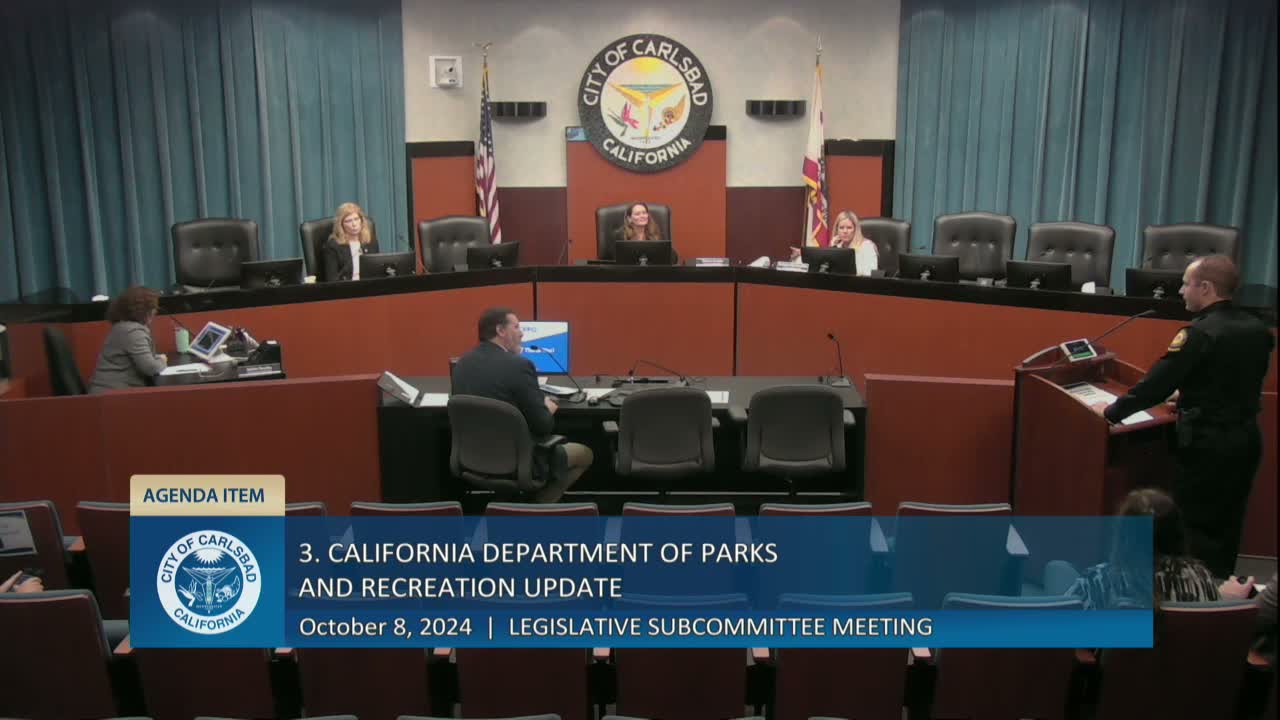
A North Sector superintendent for the California Department of Parks and Recreation told the Carlsbad legislative subcommittee that state parks operates two park units inside Carlsbad city limits — Carlsbad State Beach (about 1.7 miles from Oak Avenue south) and South Carlsbad State Beach (about 3.5 miles of coastline) — and described several ongoing coastal projects and adaptation efforts.
Sean Homer said Carlsbad State Beach and South Carlsbad State Beach host concessions and multiple parking lots, and that the South Carlsbad campground includes roughly 223 campsites with nightly rates he described as ranging from $50 to $140. He said Carlsbad State Beach will act as a receiver site for the Agua Hedionda lagoon dredge scheduled to start this fall and run into 2025, and South Carlsbad State Beach is a receiver site for the SANDAG Batiquitos Lagoon/double-track project (planned to begin this fall and to include multiple dredging cycles over several years).
Homer summarized a dune-restoration pilot that is producing higher sand elevation and increased native dune vegetation in early results, and said parks completed a sea-level-rise vulnerability assessment and are now identifying adaptation strategies, including a redesign of one campground access ramp at the campground’s southern end. He said that project went out for public comment, included on-site workshops and virtual options, and that contractors are preparing design options for review by the Coastal Commission.
Councilmembers asked for date certainty on dredging schedules; Homer said state parks is waiting for Channel Side Water to provide a firm start date for Agua Hedionda and noted state parks has completed its permitting. On Batiquitos timing, Homer said he would rely on the California Department of Fish and Wildlife and SANDAG coordination; he accepted a request to provide the subcommittee with community-outreach results for the ramp redesign.
The subcommittee flagged multiagency coordination and longer-than-typical dredging cycles (the Batiquitos cadence has stretched from roughly 3–4 years to nearly 8 years between maintenance events) as an area needing clearer timelines. Staff agreed to follow up with the Beach Preservation Commission reports and to obtain the public-feedback summary on the proposed access ramp.