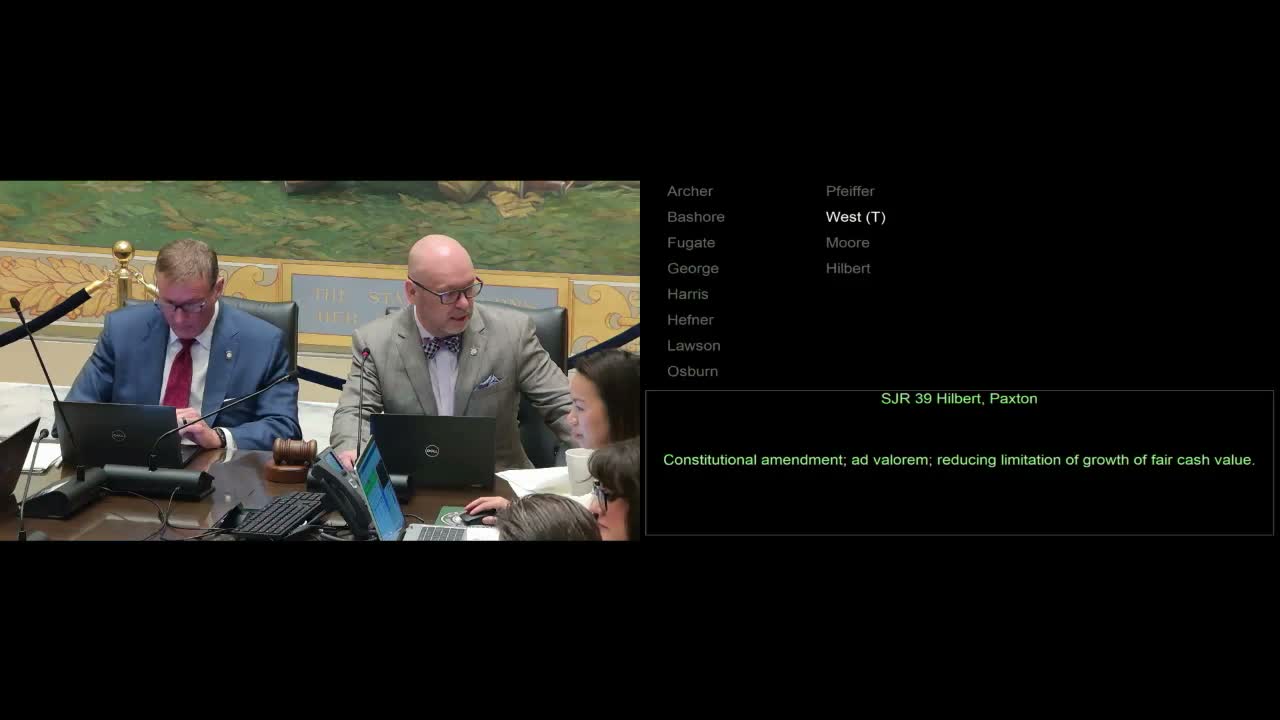
Oklahoma committee advances resolution to let voters cap homestead valuation growth at 1%
Loading...
Summary
A House committee voted to report SJR 39 "due passed," advancing a joint resolution that would ask voters to cap annual homestead valuation growth at 1% (non‑homestead remains at 3%). Supporters said it reins in valuation growth; opponents warned of county revenue effects.
A House committee voted to report SJR 39 "due passed," moving a joint resolution to the ballot that would change the annual growth cap on homestead property valuations from 3% to 1% while leaving other property capped at 3%.
Representative George, who presented SJR 39, said the measure "does not cut any property taxes" but instead "throttles the growth" of valuations after several years of sharp increases in assessed values. He argued the change would give homeowners relief from year‑to‑year valuation jumps and allow voters to decide whether slower growth is preferable.
Committee members pressed presenters on the proposal's fiscal effects. Representative Pfeiffer asked whether property valuations reset on sale and whether counties would see revenue declines; presenters confirmed that sales establish new baselines and can produce one‑time revenue increases, so a cap on annual growth would not freeze revenues for properties that change hands.
Several members linked the debate to previous legislation. One lawmaker cited a recent grant program (HB 2914) that created an $18,000,000 grant process to support rural county sheriffs; presenters said that program was funded from marijuana‑related revenues and would remain in place, while SJR 39 would only limit future valuation growth rather than cut existing funds.
Supporters framed the resolution as tax-relief for homeowners after years of rising valuations; critics warned it could constrain counties' ability to fund services such as roads, bridges and courts. After one‑minute rounds of debate, the committee recorded a final tally of 10 Aye and 2 Nay and reported the joint resolution out as due passed. The resolution now proceeds to the next step for placement on the ballot if subsequent procedures are completed.