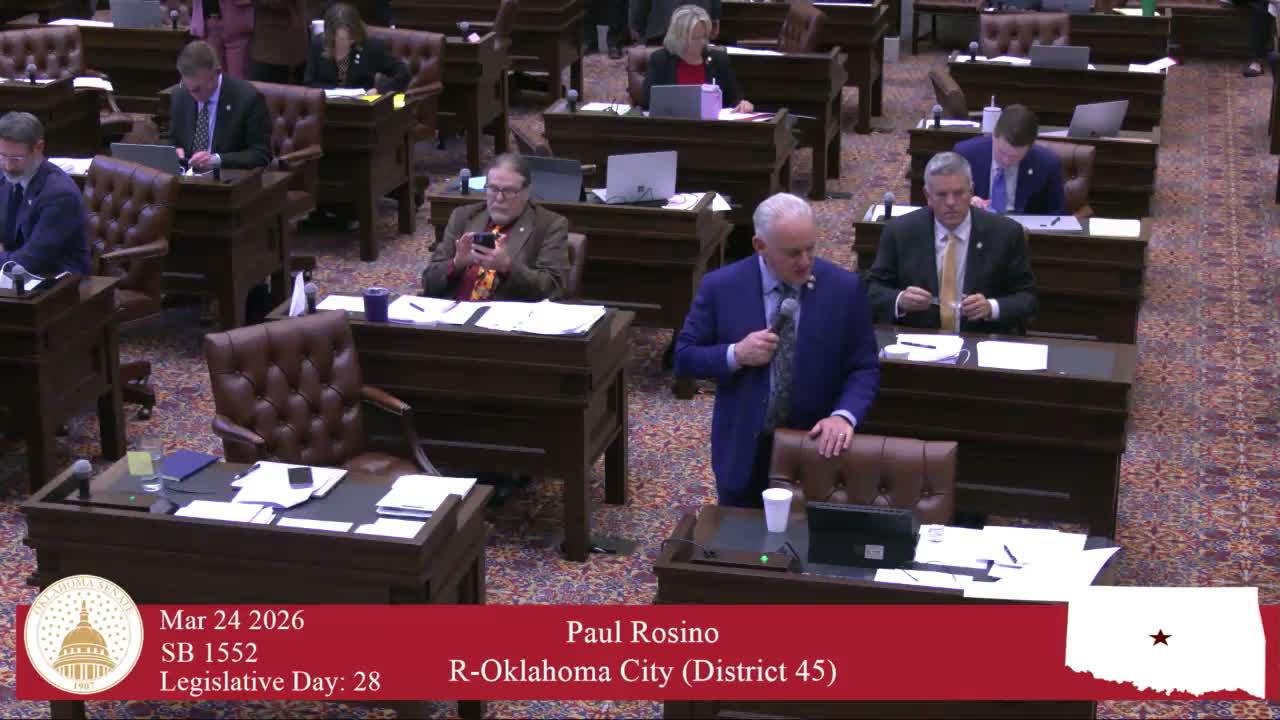
Senate narrowly approves county home‑rule pilot after hours of questions about fairness and scope
Loading...
Summary
The Oklahoma Senate approved SB 15‑52 to let the largest counties pursue county home‑rule charters via voter referendum, after extended questioning about population thresholds, Fourteenth Amendment fairness and guardrails for rural representation. Final vote: 26–18.
The Oklahoma Senate passed legislation on March 2 that would let certain larger counties create county home‑rule charters and put them to a local vote, a change supporters said would give high‑growth counties more local flexibility and critics warned could create unequal treatment across counties.
Minority Leader Kurt, the bill's floor sponsor, told senators SB 15‑52 does not mandate changes for counties but gives ‘‘options to adopt their own local governance structure’’ and requires a charter commission and voter approval. He said the measure updates an existing population threshold in state law so that the option will be available to counties only if and when they grow into it.
Why it matters: Proponents said the bill recognizes different needs in high‑population counties and would allow local officials and voters to tailor services and governance closer to residents. ‘‘This is the kind of conversation I'd like to have regularly where we're truly looking at authority and power and who decides what,’’ the sponsor told colleagues.
Opponents raised constitutional and equity concerns, arguing a population gatekeeper would permit similar counties to be treated differently and exposing the law to Fourteenth Amendment equal‑protection challenges. Senator Dusty Devers framed the question in legal terms: he asked whether ‘‘conditioning home‑rule authority on a shifting population threshold rather than applying it uniformly to all counties’’ could be arbitrary and unfair.
Guardrails and process: Sponsors pointed to written statutory safeguards in the Home Rule Charter Act (title 19, chapter 1, section 8.5) retained in the bill that limit charter provisions that conflict with state law and require significant representation from unincorporated areas on any charter committee. The senator presenting the bill said a charter only becomes effective after a county vote, and the statute specifies commission makeup and ballot timelines.
Floor dynamics: The floor record shows prolonged, detailed questioning about how charter commissions form, how municipal boundaries and bonding rules would be preserved, whether courts in other states had struck down similar laws, and whether charter commissions would disadvantage rural, unincorporated residents. Several senators said they support local control in principle but worried the threshold approach effectively makes ‘‘population control’’ the gatekeeper for local authority.
Vote and next steps: After extended debate and a roll call, the Senate recorded a final vote of 26 ayes and 18 nays and declared SB 15‑52 passed. Sponsors said the measure will proceed to enrollment and then the governor's consideration. If enacted, affected counties would still need to form a charter commission and win majority voter approval to adopt a home‑rule charter.
What remains unresolved: Multiple senators asked for additional specifics about examples from other states, empirical evidence that larger counties need this option, and whether the law could be subject to court challenge. The legislature and stakeholders may return to those points in follow‑up drafting or committee work.