Get Full Government Meeting Transcripts, Videos, & Alerts Forever!
Get email alerts on the Doe Grant topic
No spam. Unsubscribe anytime.
Fort Pierce Utility Board approves roughly $5.8 million DOE GRIP grant to modernize electric grid
Summary
The board approved a U.S. Department of Energy Grid Resilience and Innovation Program (GRIP) grant of about $5.8 million to fund transformer upgrades, a Totten Substation ring-bus conversion and deployment of 400 automated devices; the grant includes a community benefits plan and a reduced local match due to Fort Pierce’s disadvantaged-community designation.
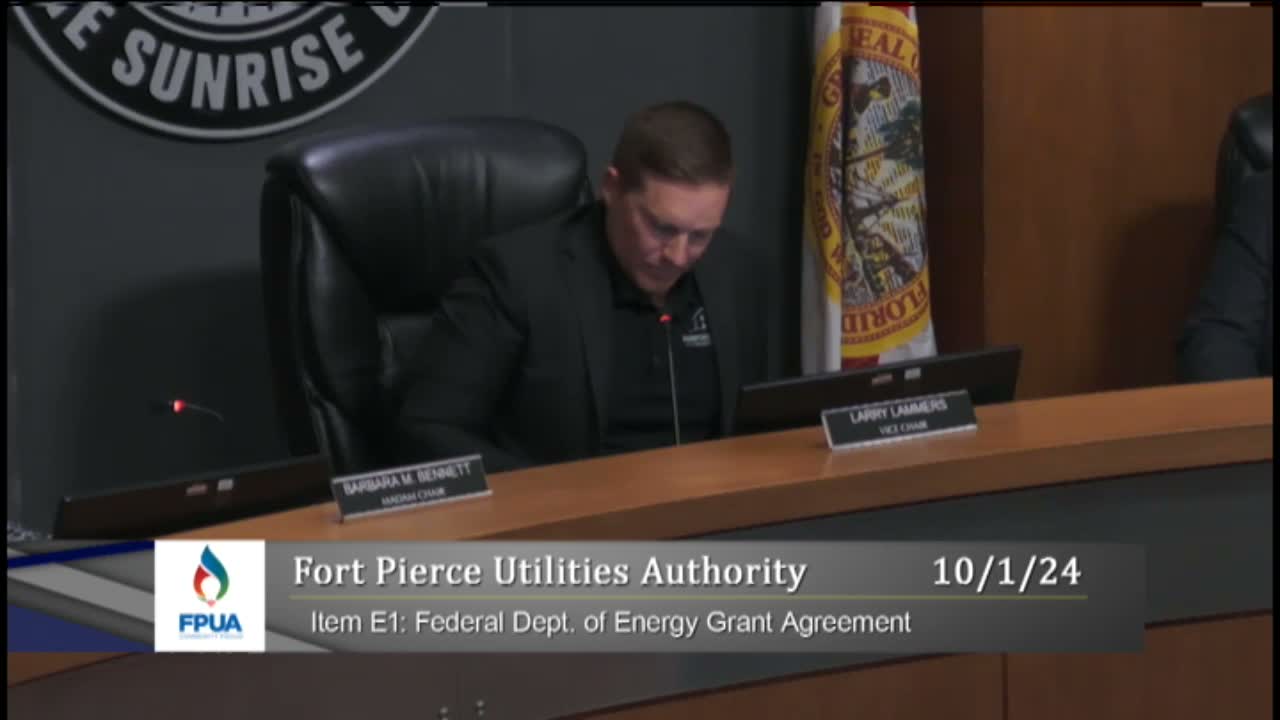
At its Oct. 1 meeting, the Fort Pierce Utility Board voted to approve a grant agreement with the U.S. Department of Energy for the Grid Resilience and Innovation Program (GRIP), a package of electric-grid upgrades worth about $5.8 million in federal funds.
Rachel Tennant, FPUA’s director of public affairs and sustainability, asked the board to sign the agreement and described a three‑year project running from October 2024 through September 2027. "I am here to request your approval of the grant agreement with the Federal Department of Energy. It's approximately $5,800,000 toward upgrades for our electric grid," Tennant said.
Staff said the work will include upgrading two power transformers at the Hartman Substation (increasing capacity), replacing four aging distribution transformers at three substations, converting the Totten Substation to an automated ring-bus configuration, and deploying 400 automated "trip savers" to reduce momentary outages and limit truck rolls. Tennant also described a contractually required community benefits plan that calls for annual public presentations to the Utility Advisory Committee, stakeholder roundtables using a "strategic doing" model, continued community surveys, and training for at least two apprentice linemen.
Tennant told the board that, while many DOE grants typically require a 50% local match, Fort Pierce’s designation as a disadvantaged community under DOE climate‑justice tools reduced the match obligation to roughly one‑third of project costs. Board members noted that combining the federal award with the local match would put the program’s budget at roughly $7 million, an approximate figure raised during discussion.
Board members questioned whether previously purchased equipment would be redeployed and how the Totten ring-bus project related to earlier Totten upgrades; staff clarified the ring-bus conversion and other capacity projects are related but distinct, and some distribution transformers previously procured would be applied where appropriate. Staff also explained trip savers automatically reclose on fleeting faults and that the ring-bus configuration isolates sections of the 69‑kV loop to improve redundancy and recovery.
A motion to approve the grant agreement was made and the clerk called the roll; the board voted to approve the agreement. After the vote, Cisneros told the meeting he would follow up on other items raised during public comment.
The board’s approval moves the award from "awarded" to "active" status in the utility’s grants portfolio and authorizes staff to proceed with onboarding and coordination with the DOE Grid Deployment Office. Next procedural steps include finalizing the grant agreement logistics, procurement for transformers and ring-bus equipment, and community-benefits scheduling.