Get Full Government Meeting Transcripts, Videos, & Alerts Forever!
Get email alerts on the Education Student Supports topic
No spam. Unsubscribe anytime.
Communities In Schools tells Austin public‑health commission it serves 28,245 local students, warns of possible 10% city contract cut
Summary
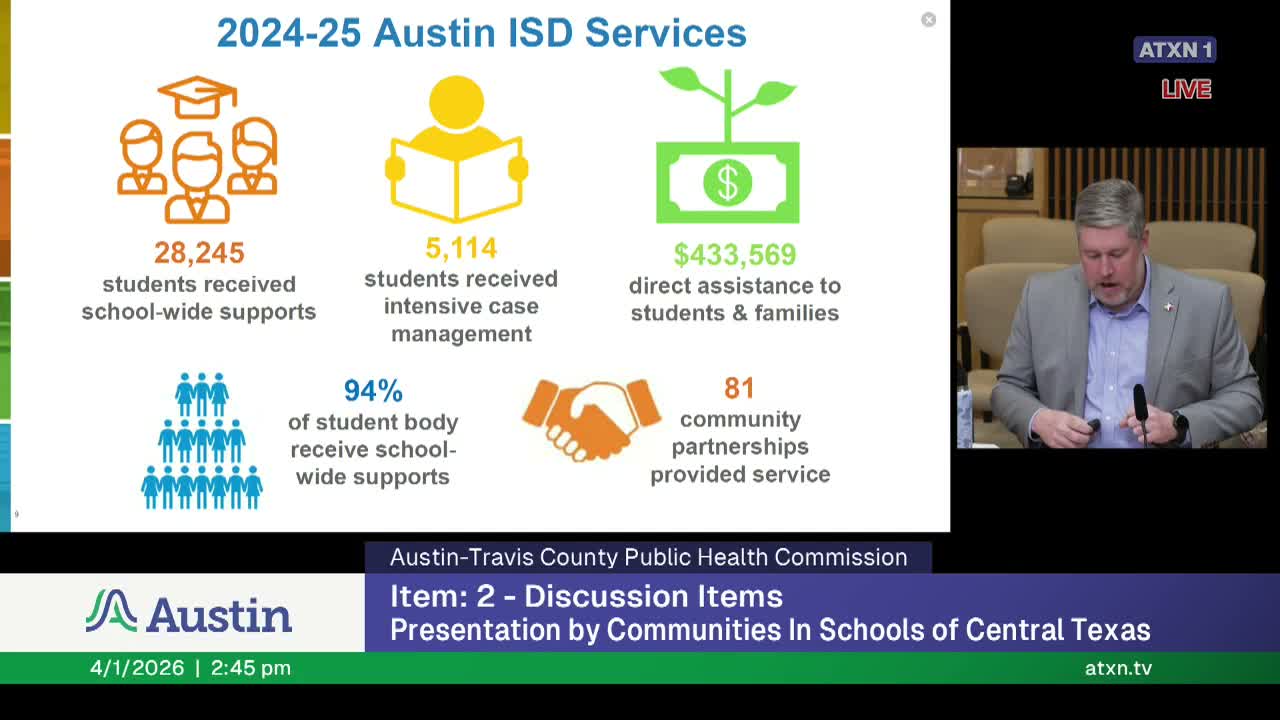
Communities In Schools of Central Texas told the Austin‑Travis County Public Health Commission it provided Tier‑3 case management to roughly 5,114 students in Austin ISD this year and delivered $433,000 in one‑time family assistance; presenters said a likely 10% reduction in city social‑service contracts could threaten services.
Communities In Schools of Central Texas outlined its campus‑based support model and student outcomes to the Austin‑Travis County Public Health Commission, reporting widespread reach across Austin ISD and partner districts.
Jacob Reach, chief of operations for CIS Central Texas, told commissioners the nonprofit uses a three‑tier model — campus‑wide supports, targeted group programs and individualized Tier‑3 case management — to address barriers such as trauma, chronic stress and food insecurity that impede learning. “When students feel safe and supported, the brain can rewire and it can heal,” Reach said, arguing that constant caring relationships drive the program’s success.
Reach said CIS served 28,245 students in Austin ISD this year and provided intensive Tier‑3 case management to about 5,114 students. The organization reported approximately $433,000 in one‑time direct assistance to families as short‑term stopgap support and listed other measurements of impact: 93% of students with self‑regulation goals showed gains, 99.9% of case‑managed students remained enrolled, 99.3% graduated or were promoted and about 90.8% improved in at least one targeted goal area.
A colleague noted a recent analysis by Harvard’s Ed Redesign Lab that used Texas Education Agency data and CIS records; the lab estimated a 5.2 percentage‑point increase in graduation rates among students who received CIS services. “That study looked at long‑term outcomes across the state,” Maria Campos said, describing the partnership with TEA that enabled the research.
Reach also summarized local funding: the city of Austin provides roughly $837,000 to CIS programs (excluding Travis County support), and CIS uses those dollars to leverage additional public and private funding — Reach estimated about $12.4 million in leveraged resources, or roughly $14.85 of additional support per city dollar for direct program costs.
Commissioners pressed staff on program coverage and stability. Reach said CIS prioritizes Title‑I campuses and that a typical campus program costs about $133,000 with campus or district partners paying a share (Austin’s share was described as around 35% of direct program cost). He warned that city social‑service contracts are likely to see a 10% reduction and that CIS is planning for that possibility while seeking braided funding from districts, foundations and other partners.
The commission discussed possible roles it could play in championing mental‑health services in schools and in connecting CIS with other city and county programs. Reach and Campos offered to provide more historical documentation on state appropriations and other data to commissioners.
The commission did not take formal action on funding during the meeting; commissioners requested follow‑up materials and said they would continue conversations about supporting school‑based mental‑health services.