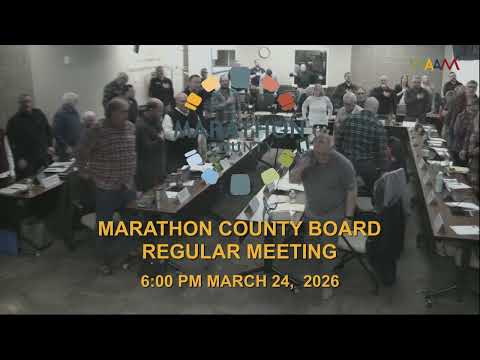
Marathon County board adopts 2026 comprehensive plan after hours of amendments and debate
Loading...
Summary
The Marathon County Board of Supervisors adopted the updated Comprehensive Plan 2026 (Ordinance O-13-26) March 24, approving multiple amendments on livability, energy language, data centers, radon/lead remediation and AI; several votes carried with dissent.
The Marathon County Board of Supervisors on March 24 approved the Marathon County Comprehensive Plan 2026 (Ordinance O-13-26) as amended, following several hours of staff briefing, supervisor amendments and extended debate over energy and land-use language.
County Administrator Leonard opened the explanation of proposed edits and staff-recommended amendments, saying the packet includes a set of changes compiled from supervisors and that staff would take any offered amendments "either individually or if... a couple of them... work well as a package" before the board considered them. Leonard also described language changes to reflect that the county would "actively review and regulate when allowed by state law large energy projects." (Administrator Leonard)
The board accepted a series of amendments. Vice Chair Dickinson successfully moved Amendment 1 (livability language), which was adopted unanimously. Amendments 2, 3 and 4—language cleanups clarifying references to "energy projects" and large-scale wind and solar—were considered individually after a motion to separate; each carried, though several were not unanimous. Amendment 5 added background language about data centers and battery energy storage systems. Amendment 6 inserted references to radon and lead remediation in implementation strategies and passed unanimously. Amendment 8 added specific references to automation, artificial intelligence and data analytics for both external economic-development efforts and internal county operations; Supervisor Lemmer said she wanted the plan to "put in this 10/20 year plan the word AI or automation or artificial intelligence" to ensure the county is prepared and can provide training and oversight. (Supervisor Lemmer)
Amendment 9 prompted the most extensive debate. Supervisor Sandalski argued the county should "promote clean coal, natural gas, and nuclear energy... without destruction of thousands of acres of prime, fertile farmland," asserting those technologies are more durable and reliable than industrial wind and solar. Opponents, including Supervisor Rosenberg and Supervisor Robinson, disputed the framing: Rosenberg said there is "no such thing as clean coal," and Robinson raised concerns about siting and water needs for new nuclear facilities. After multiple motions and an amendment-to-the-amendment, the revised language carried but not unanimously.
After taking the amendments together, the board voted to adopt the comprehensive plan ordinance as amended; Chair Gibbs announced the motion "carried, but is not unanimous." The ordinance number in the meeting record is O-13-26.
Why it matters: The comprehensive plan sets the county's long-term land-use goals and background policy language that guides future zoning, siting discussions and economic-development priorities. The adopted changes add county-level references to emerging technologies, data centers and energy-storage facilities and explicitly call out radon and lead remediation among housing priorities. The board frequently noted that the county can act only "when allowed by state law" on certain large-scale energy projects.
What's next: The adopted plan will serve as a guiding policy document; several supervisors noted that specific regulatory authority for large projects (for example, projects above a state threshold overseen by the Public Service Commission) remains governed by state processes. The board's packet identifies the relevant draft text and packet pages for future reference.
Sources and attribution: Quotes and attribution are taken from the March 24 board meeting transcript. Speakers quoted or paraphrased above are included in the article's speaker list.