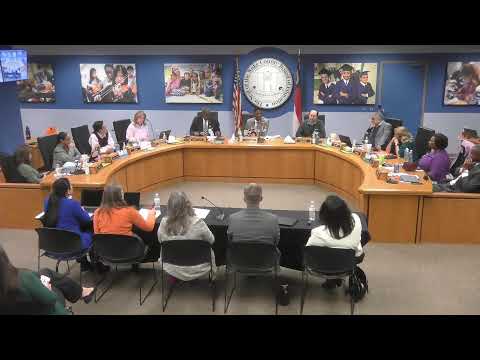
Wake County staff propose phasing out CCK and Essentials classes and changing CCR allotments; board raises compliance and service concerns
Loading...
Summary
Administrators told the Wake County Board of Education they plan to close cross‑categorical kindergarten (CCK) and phase out Essentials classes over two years because many teachers lack required dual core content licensure; staff also proposed allotment changes that would increase CCR caseloads, prompting board members to warn of worse services and higher compensatory‑service risk.
Administrators told the Wake County Board of Education they plan to close cross‑categorical kindergarten (CCK) classrooms and phase out 'Essentials' classes over the next two school years, citing licensure and compliance concerns.
Program staff said many CCK and Essentials teachers hold special education licensure but not the core content licensure required to deliver full subject instruction in ELA or math. Staff argued that having core instruction delivered by a teacher licensed in that subject is both legally cleaner and better for students’ long‑term access to grade‑level curricula. One program presenter said, "There is a compliance issue with many of these classrooms," and explained that students identified for regional placements will have IEP teams determine appropriate services at their base schools.
The program changes came alongside proposed allotment adjustments for cross‑categorical resource (CCR) teachers that staff say would reduce overall teacher months by about 1,300 (roughly 130 positions) under the new formula and increase individual CCR caseloads in many schools (staff cited +5 students in elementary, +6 in middle and +3 in high school as possible examples depending on how schools choose to schedule services).
Board members and several presenters raised concerns that increased caseloads will reduce the time available to implement IEPs and could increase compensatory‑service obligations if students do not receive required services. Board members asked how the district will adapt schedules, which schools will get priority protections, and whether professional development and regional supports will be in place to prevent service erosion.
Program staff responded that the district will roll out a regional support model on July 1, with primary points of contact assigned to schools and scheduling workshops already underway; they said staff plan three intensive professional‑learning days for special‑education teachers next year and targeted training for general‑education teachers (including partnerships with outside organizations for behavior management training). Staff also emphasized reconciliation at the 20‑day student count each fall to adjust allotments as needed.
Parents, teachers and board members asked for specific data about CCK outcomes (for example, how many CCK students repeated kindergarten), the number of CCK teachers with dual content licensure, and the dollar value of eliminated vacant positions; administrators said they would provide those figures after the meeting. Program staff said current students in CCK will finish the year and transition back to base schools as historically practiced, and that IEP teams will determine the best placements.
Board members said they supported bringing forward better options and pleaded for careful, transparent planning to avoid harm to students, to ensure legal compliance and to restore community trust before any personnel moves were finalized.