Flagstaff planning commission recommends ban on commercial data centers after heated public comment
Loading...
Summary
The Planning and Zoning Commission voted 4-3 to recommend Proposal 2 to City Council, a zoning-text amendment that would bar commercial data centers in city limits, after staff outlined legal risks and dozens of speakers raised concerns about water, energy and neighborhood impacts.
The Flagstaff City Planning and Zoning Commission voted 4-3 on April 4, 2026 to recommend that the City Council adopt Proposal 2, a zoning-text amendment that would prohibit commercial data centers within city limits.
Staff warned commissioners that an outright ban or very prescriptive local rules could invite legal challenges under Arizona’s property-compensation provisions (referred to in the hearing as Prop 207) and that the city’s code changes could be preempted by state law. "If that claim is viable, we would either waive the claim or we would go to court, and if the court did not find in our favor, then we would have to compensate the property owner for the loss of value," staff told the commission.
The recommendation followed more than an hour of commissioner questions and public comment focused on water, energy use, heat and noise. Several speakers asked that any data-center allowance be controlled through a conditional use permit (CUP) or be banned outright; others urged measurable, performance-based standards. "I fear the zoning codes are not enough," resident Kevon Kosterpoor said, asking the commission to require monitoring and long-term study of impacts on residents and land.
Advocates for a ban framed Flagstaff as a high-desert community whose limited water supply and local priorities could not justify hosting high-demand industrial uses. Kyra Russo, president of Friends of the Rio de Flag, told commissioners: "We live in a high desert ... we would ask that we take the greatest precautions possible with our community." Michelle James, executive director of Friends of Flagstaff's Future, said the group supports a ban or moratorium and asked staff to clarify what "renewable to the greatest extent possible" would mean in practice.
City staff and technical witnesses described typical scales and mitigation options. CJ Perry, Flagstaff’s chief information officer, said smaller, locally scaled facilities can offer benefits such as co-location of municipal servers and reduced latency for services like telehealth, but that Flagstaff is unlikely to host hyperscale campuses seen in the Phoenix area. Staff said air-cooled facilities in the city typically top out near 10,000 square feet before water cooling becomes common and stressed that any larger or water-cooled facility would raise different regulatory questions.
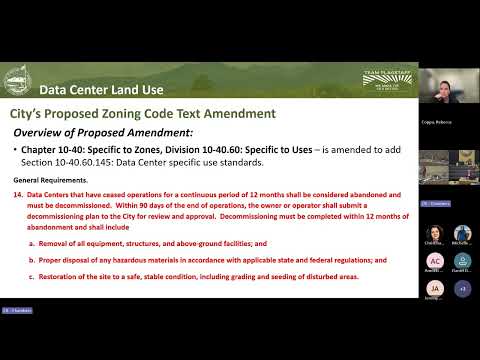
Commissioners also pressed staff on decommissioning and public-health findings. "If they've ceased operations for a continuous period of 12 months, they're considered abandoned," Commissioner Norton asked; staff acknowledged the risk that an operator could disappear and leave cleanup costs behind. Senior Assistant City Attorney Christina Rubalcaba clarified that Northern Arizona University (NAU) land is not subject to city zoning if the university builds a data center for its own governmental purposes, but a commercial operation on NAU land would be subject to city code.
Commissioner Lukey moved the recommendation to City Council to approve PZ2600018 (Proposal 2) and Commissioner Norton seconded. After brief discussion about ancillary uses and potential consequences for hospitals or existing businesses, the commission voted 4-3 in favor; the recommendation will be forwarded to City Council for final action.
The commission concluded general business and adjourned at 05:51.