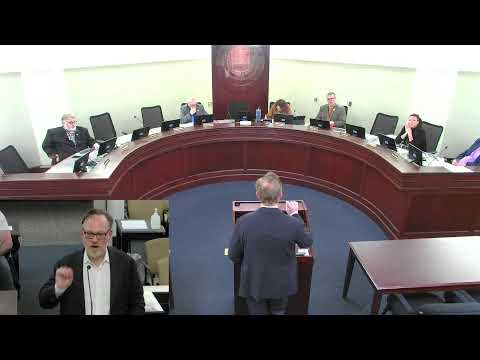
County committee hears ambassadors’ case for multi‑year hotel‑tax support
Loading...
Summary
Presenters from Bethlehem and Easton outlined ambassadors programs that provide cleaning, safety and hospitality in downtown corridors and asked Northampton County to include the programs in a five‑year recurring hotel‑tax grant to stabilize funding beginning fiscal 2027.
Sean Ziller, deputy director of economic development for the City of Bethlehem and executive director of the Bethlehem Economic Development Corporation (BEDCO), and Jared Mast, executive director of the Greater Easton Development Partnership, told the Northampton County Economic Development Committee on April 2 that ambassador teams in South Bethlehem and downtown Easton provide cleaning, safety and hospitality services and need stable, multi‑year hotel‑tax funding.
Ziller said the Southside Bethlehem Ambassadors, a five‑person team operating under a contract with Block by Block since 2014, focus on trash pickup, snow removal, weed abatement, graffiti removal and visitor assistance and act as additional “eyes and ears” that can connect residents and visitors with police and social services. He highlighted program metrics, saying ambassadors collected about 100,000 pounds of trash in 2024 and roughly 94,000 pounds in 2025 — about 197,000 pounds combined — and that the team counts thousands of visitor interactions and “greetings” as part of its hospitality work. “If the program went away tomorrow, you would see a significant difference in just how South Bethlehem is growing and flourishing,” Ziller said.
Mast described Easton’s Ambassadors, established in 2008, and said his organization recently brought ambassador staff in‑house after nearly two decades with a contractor to increase operational flexibility and staff stability. He listed services the Easton team provides — snow removal, power washing, watering planters, hazard waste removal and event support for Farmers Market and other downtown festivals — and said historical county hotel‑tax support peaked near $50,000 and has typically ranged about $30,000–$35,000.
Both presenters framed the request as a public‑private partnership that leverages municipal, institutional and developer contributions; they asked the county to include the ambassadors in a non‑competitive or multi‑year portion of the hotel‑tax funding cycle so the programs can plan more efficiently. County staff had previously described the current proposal as a five‑year, recurring hotel‑tax grant to be budgeted for fiscal 2027, not this fiscal year.
Committee members offered praise and local examples of ambassadors’ community impact. One commissioner recounted a longtime worker who regularly greeted a market vendor and became part of that vendor’s daily routine; another commissioner thanked the teams for turning out at local events after an area hotel fire. Ziller emphasized attention to ambassadors’ mental health and retention, noting many live in the neighborhoods they serve.
The committee chair said a resolution to vote on funding would appear on the full council agenda; no committee vote on the request was recorded during the meeting.