Get Full Government Meeting Transcripts, Videos, & Alerts Forever!
Get email alerts on the Ranked Choice Voting topic
No spam. Unsubscribe anytime.
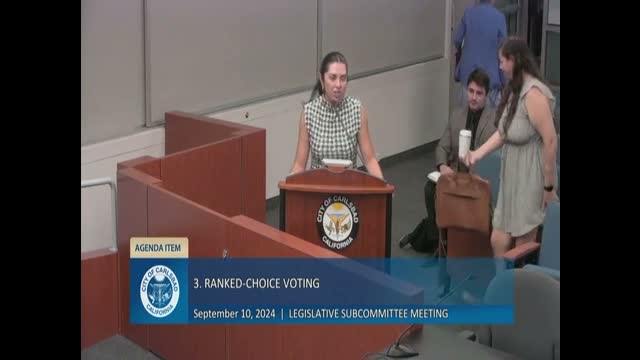
Ranked‑choice voting draws split response at Carlsbad subcommittee
Summary
A split panel — Marcela Miranda Caballero for ranked‑choice voting and Paula Witzel opposed — presented to the Carlsbad Legislative Subcommittee; councilmembers asked about costs, machine readiness, voter education and potential ballot exhaustion; no council action was taken.
Two presenters laid out opposing views on ranked‑choice voting (RCV) at the Carlsbad Legislative Subcommittee. Marcela Miranda Caballero, executive director of the California Ranked Choice Voting Institute, framed RCV as a way to elect majority winners and to encourage broader, more civil campaigns. "Ranked choice voting enables voters to rank candidates in preferred order... so when you’re running for office, you have to win with that 50% plus 1," she said, and noted that "Dominion Voting Systems... has the capability of using ranked choice voting" though a licensing fee would be required.
Paula Witzel, speaking as a Chula Vista citizen and former county Republican leader, presented an opposing view and showed a video that argued RCV can exhaust ballots and produce winners without a majority of all ballots cast. The video and Witzel cited Oakland and Maine examples and asserted that in some large contests a high share of ballots can become "exhausted" or not count in a final round. Witzel said RCV implementation can be costly and posed transparency concerns for centralized machine counting.
Councilmembers pressed both presenters on practical issues: how long tabulation could take, whether San Diego County’s Dominion equipment is ready for an RCV module, who would pay up‑front licensing and voter education costs, and the risk of confusing older voters. Marcela said jurisdictions can limit how many rankings voters may mark to reduce complexity and that RCV ballot error rates are comparable to other systems; Paula urged caution, citing examples where jurisdictions subsequently repealed or reconsidered RCV.
Councilmembers asked staff to collect the presenters’ cited sources and to verify machine capabilities and costs with the county registrar. The subcommittee took no formal action and did not refer RCV to a committee or ballot at this meeting; presenters agreed to provide the PowerPoint citations and links to staff.