Get Full Government Meeting Transcripts, Videos, & Alerts Forever!
Get email alerts on the Public Utilities topic
No spam. Unsubscribe anytime.
San Diego utilities report sharply lower call wait times and held‑bill backlogs
Summary
The Public Utilities Department told the City Council on May 12 that call wait times have fallen sharply and the held‑bill backlog has been reduced dramatically after technology and staffing changes; staff outlined next steps including a delinquency program to comply with Senate Bill 998.
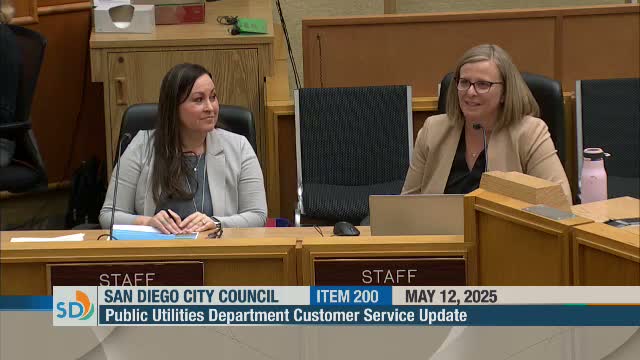
The San Diego Public Utilities Department told the City Council May 12 that a year of technology upgrades and staffing changes has substantially improved customer service metrics.
Lisa Slaya, executive assistant director of the Public Utilities Department, and Michelle Costello, deputy director for customer support, said the department now handles roughly 85,000 calls a year, about 40,000 web forms and 31,000 emails, and processes about 2,000,000 bills and $384,000,000 in payments annually. Costello said the department reduced the average speed of answer by roughly 92% over the past year and that month‑to‑date figures in May show an average wait time of about 69 seconds.
“Customers are offered a post‑call survey,” Costello said. “We are showing 85% of our customers are very satisfied or satisfied with the service that they received, and 87% of our customers are reporting that we were able to fully resolve the issue they called about within that call.”
Staff also reported a major decline in the held‑bill backlog. Costello said the team reduced an earlier backlog of roughly 30,000 held bills by about 90–95%; current figures presented showed about 1,300 held bills citywide, representing less than 1% of customers. She said nearly 80% of held bills are less than six months old and about 91% are held for only one billing cycle.
Council members praised the results and asked staff how to sustain the improvements. Council member Von Wilpert commended the reduction in complaints from constituents and asked how council could continue to support the department’s investments in people and technology. Costello and Slaya emphasized a “continuous improvement” approach and said further investment will be needed to maintain progress.
Looking ahead, Costello said the department will roll out a delinquency program to help customers with past‑due balances, including payment plans that can spread balances over 18 billing periods. She said the policy work will comply with Senate Bill 998 and include strategic communications to encourage customers to enroll in payment arrangements.
The presentation credited new telephony and case‑management platforms (Amazon Connect and a Salesforce implementation) and workforce analytics for much of the improvement. Staff invited council members to request follow‑up briefings, district‑level breakdowns of held‑bill data and continued oversight as the department implements the delinquency program.