Get Full Government Meeting Transcripts, Videos, & Alerts Forever!
Get email alerts on the Public Safety topic
No spam. Unsubscribe anytime.
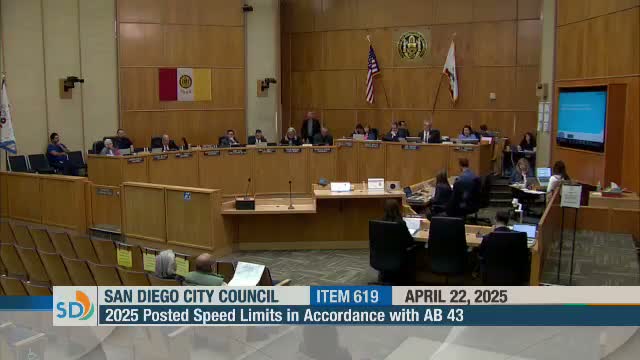
Council uses AB 43 to trim posted speeds on 11 business corridors, retain limits on 72 segments
Summary
Using new state flexibility under AB 43, the council declared lower posted speeds (25/20 mph) for 11 business‑activity corridors, retained limits on 72 segments that would otherwise have increased, and directed a citywide speed‑management plan to return in 2026.
The council voted unanimously to implement an initial set of speed‑limit changes under Assembly Bill 43, lowering posted speeds within 11 business‑activity corridors to 25 or 20 miles per hour where statutory criteria were met. Transportation staff said AB 43 allows local governments to reduce enforceable posted limits more aggressively than prior law in areas with concentrated retail, parking, crosswalks and vulnerable users.
Deputy Director Maggie McCormick told the council staff evaluated 38 corridors for eligibility against AB 43 criteria (four‑lane max, pre‑ and post‑district posted speeds of 30 mph or less, and at least three of four other conditions such as contiguous retail frontage, on‑street parking and frequent marked crosswalks). The council also approved retaining speed limits on 72 segments where prior engineering surveys might otherwise have required increases — a procedural protection staff labeled prevention of 'speed creep.'
Implementation: Staff said signs for the initial 11 corridors will be installed this summer, subject to funding and phasing, and that a comprehensive citywide speed‑management plan funded by an SS4A grant will be completed by December, with further proposals to council in early 2026.
Council reactions: Supporters framed reductions as a Vision Zero measure that materially lowers injury and fatality risk — citing research that even small speed reductions significantly reduce pedestrian fatality risk. Some council members sought clarity on timeline and phasing for sign installation and a greater emphasis on pairing limits with traffic‑calming treatments.
What to expect: The adopted item sets immediate legal posting changes for specific corridors and creates a schedule for a broader, data‑driven speed‑management plan to evaluate additional reductions in 2026.