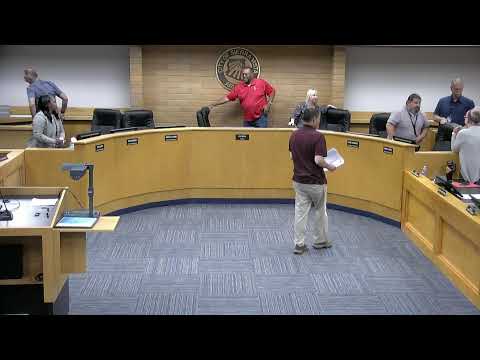
Police chief urges approval of regional SWAT IGA to expand tactical capacity
Loading...
Summary
Sierra Vista police chief asked the council to approve an intergovernmental agreement with Cochise County to formalize a regional SWAT team, citing staffing shortfalls, shared equipment advantages and improved training; council members pressed on liability, command structure and deployment rules. No formal vote was taken at the work session.
The Sierra Vista police chief asked the council to approve an intergovernmental agreement (IGA) with Cochise County to formalize a regional Special Weapons and Tactics team, arguing the partnership will increase operational capacity, common training and access to specialized equipment.
The chief told the council the city’s SWAT element has historically been authorized for up to 15 operators but often only fields about 10, leaving the department short when callouts occur. “Sometimes there’s a need for specialized resources, specially trained officers, with equipment, that can handle the high risk situations that are outside the routine,” the chief said, describing hostage, barricade and extended-duration incidents as the primary drivers of the change.
Under the proposed IGA, the sheriff’s office would serve as the lead agency and the participating agencies would adopt a single combined SWAT operations manual. The IGA establishes an oversight committee, which the chief said includes the sheriff and the police chief and will approve team commanders and retention decisions. Each agency would keep its own budget; the IGA does not merge accounting or eliminate existing local funding, the chief said.
Supporters argued the regional approach improves safety and capability. A council member who has observed regional dispatch and joint fire operations said alignment “makes much more sense” and thanked the chief and the sheriff for pursuing the partnership. The chief also pointed to equipment and safety benefits: pooled assets would increase the number of armored vehicles and breaching tools available on a callout.
Council members pressed staff on specific concerns. One asked whether participation would expose city officers to additional liability when they operate outside city limits; another asked whether joint deployments would always be required or whether local standalone responses would remain possible. The chief said liability issues had been reviewed and that the IGA preserves incident-command roles by jurisdiction while enabling the regional commander to have tactical command during joint operations. He said the agreement allows agencies to determine each deployment’s size and composition and that smaller, low-key responses could still be handled with limited personnel after consultation.
Captain John Georgi of the Cochise County Sheriff’s Office addressed the council in support of the IGA, noting long-standing operational ties and shared training. The chief said the regional approach also “leverages us in a better position to secure some more grant funding as well.”
Council members asked about recruitment and compensation for operators. The chief said SWAT assignment is collateral and hazardous-duty ad pay is provided after an operator becomes deployable; he emphasized that operators must earn deployability by completing training and that pay alone is not an effective retention tool.
No formal action or vote occurred at the work session; staff said the IGA will return to council for consideration. The council indicated broad interest and asked staff to bring forward the finalized agreement and any outstanding liability clarifications before a final vote.
Provenance: topicintro SEG 381, topfinish SEG 1216.
Speakers quoted: Police chief (role: Police chief), Captain John Georgi (Cochise County Sheriff's Office).