Hearing presses utility on contractor 'field resource coordinators,' travel logs and timesheet discrepancies
Loading...
Summary
OCC counsel questioned company witnesses about how field resource coordinators oversee contractor crews, discrepancies between flight manifests and timesheets for storm MS23F, and requested unlocked supporting data; the panel ordered consolidated late-file exhibits and will resume cross tomorrow.
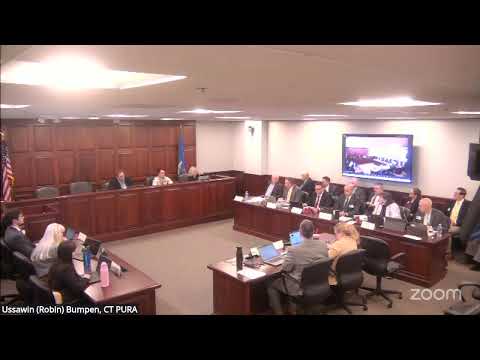
Attorney White of the Office of Consumer Counsel pressed company witnesses at a Public Utilities Regulatory Authority hearing over how contractor "field resource coordinators" are assigned and how contractor travel and timesheet records tie to invoices for storm MS23F.
The issue matters because much of the cross-examination focused on whether ratepayer-funded charges for contractor mobilization and labor are supported by verifiable records. "They're responsible for multiple crews — anywhere from 5 to 10 line crews each," a company witness said when describing the coordinators' typical workload, and the witness outlined that coordinators handle switching, tagging, safety briefings and dispatch from resource-management teams.
OCC counsel questioned whether coordinators were internal employees or vendor staff, whether coordinators remained engaged through a full storm day, and how coordinators participate in post-storm invoice and timesheet verification. Company witnesses said coordinators typically attest to crew hours and participate in post-storm reviews that evaluate contractor safety, productivity and equipment condition; the company also said invoice validation relies on multiple records (crew rosters, hiring emails and contracts) in addition to timesheets.
Attorney White flagged specific documentary inconsistencies in exhibit CLP-49a for event MS23F: flight manifests listing return flights for groups (one manifest for 16 passengers and another for about 30, with witnesses confirming 45 people traveled) did not match some time sheets that listed additional names or different home locations. "Some of the people listed on the time sheet were not on the manifest for the flight back that I can see," Attorney White said, asking the company to identify which two employees were local to Connecticut and which personnel actually flew.
The company agreed to consolidate detailed questions into late-file exhibits. The panel directed the parties to produce late file 10 — to include the names of the two local individuals identified on the time sheet and an explanation for 16 hours of travel recorded on March 16 when flights departed March 17 — and late file 12 for the number of storm-fleet vehicles deployed per storm. Attorney White also requested an unlocked Excel spreadsheet listing each Mid Con employee who worked on MS23F, with home-office location, starting point, travel mode, dates/times by category (travel/standby/work) and links to substantiating documents; the panel accepted these as late-file deliverables.
Company witnesses explained apparent mismatches in billed hours on timesheets (for example, some foremen were billed at 18 hours while others listed 16) by saying foremen may have paperwork or supervisory duties that extend beyond crew field time and that crews do not all travel together or finish at the same moment. A witness described staging activity — picking up poles and materials at an area work center, safety briefings and equipment loading — that can consume several hours before recorded "event" work time begins, which the company said explains gaps between a sheet's stated day span and when box entries record first job activity.
Regulators emphasized that detailed scrutiny is the point of the hearing. The session recessed for the day with an agreement to resume cross-examination the next morning; OCC said it hoped to compress its remaining cross into roughly three hours.
The parties committed to filing the late-file exhibits and to producing a witness at the late-file hearing if needed to clarify the spreadsheet and timesheet reconciliations. The hearing will pick up with OCC cross on the next scheduled session.