Get Full Government Meeting Transcripts, Videos, & Alerts Forever!
Get email alerts on the Public Safety topic
No spam. Unsubscribe anytime.
Weston officials say $600,000 referendum aims to restore firefighter staffing and reduce delayed responses
Summary
Village of Weston officials urged voters at an information session to approve a $600,000 referendum on the April 7 ballot to hire additional firefighters/EMS staff, citing a long decline in part‑time recruits, rising costs, longer apparatus lead times and measurable increases in delayed ambulance responses.
Village of Weston Administrator Jamie Gabbert opened an informational meeting on the April 7 ballot question and introduced fire and finance officials who described why the village is asking voters for a $600,000 levy increase.
Chief Josh Finke, who leads the district formed by the 2014 merger of Weston and Red Mountain departments, told attendees the department has "had a significant decrease in our part time staff," a trend he said mirrors statewide and national declines in volunteer and part‑time firefighters. Finke said the change forced the district to add more full‑time staff over time and that prior recruitment efforts and a federal SAFER grant application were unsuccessful.
Why it matters: Officials said staffing shortfalls have concrete consequences for emergency response. Finke cited department staffing levels (a maximum daily staffing of nine, a typical staffing of seven to eight) and said those numbers limit how many ambulances and fire apparatus the district can staff at once. "To make entry into a house fire, you have to have a minimum of four people," he said, explaining that lower on‑scene counts limit effective fire attack and rescues. He also noted that an ISO insurance re‑evaluation removed a water‑haul credit after the department sold an unstaffable tanker, and that some residents outside hydrant coverage have seen their insurance rates rise.
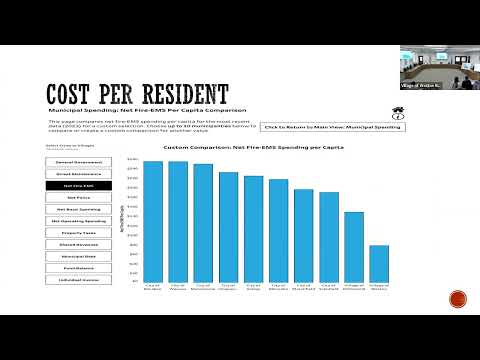
Costs and the referendum: Jessica, the village finance director, explained the referendum seeks $600,000 to fund additional personnel and showed a tax‑impact chart based on last year's net new construction number (the state requires using the prior year for a spring referendum). She said the chart shows the $600,000 figure alone and does not reflect future changes in assessed value. Officials emphasized the restriction in state statute that allows municipalities to borrow for buildings but not for ongoing personnel costs, and that the referendum is the tool to raise operational revenue now.
Officials provided several cost figures: a starting firefighter‑paramedic wage cited at about $67,005 a year, roughly $30,000 in annual benefits, about $2,000 in initial training and $4,500 for gear per hire. Finke explained that because firefighters work 48‑hour shifts, hiring one daily position requires three hires to cover all shifts.
Operational impact and recent data: Finke said the village’s 2025 goal is to reach six‑minute responses for emergent 911 calls; last year the district recorded more than 300 calls with response times over 10 minutes and 24 calls over 15 minutes. He recounted incidents where simultaneous calls left the district short — including a multi‑vehicle crash, a cardiac arrest and a house fire where it took about 20 minutes for an engine to arrive and the structure was a total loss.
Q&A highlights: Residents asked whether the six positions the referendum would fund are two per shift and where the staff would be based. Officials said staffing would be split between Weston and Rib Mountain (with more personnel in Weston because of higher call volume) and that Red Mountain had agreed to pay its share without a referendum. The village described its funding formula as based equally on population, equalized value and inspectable structures; officials said Weston normally pays about two‑thirds of the district budget and Rib Mountain about one‑third.
Interns and workforce development: Officials described a new intern program that houses three interns at the station, pays a small hourly rate when on duty (about $8.88/hour), provides room and board and covers training costs through existing state programs that subsidize roughly half of paramedic training.
What happens next: The referendum will appear on the April 7 ballot; if approved the village says it will use the $600,000 to hire multiple staff to increase daily coverage, reduce delayed responses and improve on‑scene firefighting capacity. Officials encouraged voters to review the ballot language and offered to answer follow‑up questions after the session.