Lifetime Citizen Portal Access — AI Briefings, Alerts & Unlimited Follows
Utah licensing division outlines pathways for internationally trained mental‑health professionals
Loading...
Summary
Utah’s Division of Professional Licensing explained how internationally trained mental‑health professionals can seek licensure, detailing three license levels, credential‑evaluation requirements, supervised‑experience hour thresholds (3,000 and 4,000 hours), and application steps including background checks and board review.
Xelmira Moret, who works on the international credentials team at the Division of Professional Licensing in Utah’s Department of Commerce, laid out the steps for internationally trained mental‑health professionals to pursue state licensure in a virtual seminar.
Moret said the division regulates roughly 68 professions in Utah and that mental‑health fields regulated include behavioral‑health technicians, behavioral‑health coaches, clinical associate counselors, clinical mental‑health counselors, marriage and family therapists, psychologists, licensed clinical social workers and substance‑use disorder counselors. “Mi nombre es Xelmira Moret y trabajo con la división de licencias profesionales del estado de Utah,” she said when introducing herself.
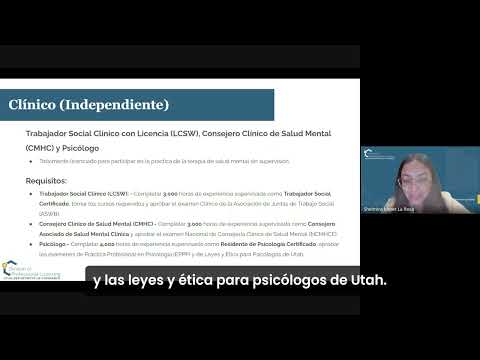
Why it matters: licensure determines who may legally provide diagnosis and therapy in Utah. Moret explained the division groups licenses into three practice levels: non‑clinical/support roles (which may perform administrative and case‑management tasks but may not diagnose or provide therapy), supervised clinical roles (authorized to perform clinical assessments and therapy only under supervision), and independent clinical licenses (authorized to practice without supervision and to supervise others).
Key details and thresholds: Moret said non‑clinical roles typically require an associate or bachelor’s degree depending on the position. For supervised clinical licenses, applicants generally need a master’s or doctoral degree in a relevant field. For independent clinical licensure the division cited specific supervised‑experience thresholds: 3,000 supervised hours for licensed clinical social workers and clinical mental‑health counselors, and 4,000 supervised hours for psychologists, in addition to the applicable national and state exams.
Credential evaluation: Applicants must submit a third‑party credential evaluation that compares foreign education to U.S. equivalents. Moret advised using evaluators who are members of the National Association of Credential Evaluation Services (NACES) for most licenses, and said certified social‑work applicants must use evaluations approved by the Council on Social Work Education (CSWE) or, in some cases, the Canadian Association of Schools of Social Work.
Application process: Moret described a two‑stage flow—presubmission and formal application. Presubmission steps include contacting the international credentials team, obtaining an approved credential evaluation and gathering course descriptions or other documentary evidence the division may request. Formal steps include filing an online or in‑person application, paying the license fee, completing a background check where applicable, proving identity (Social Security number or ITIN) and legal presence, and—when required—appearing before the relevant mental‑health board to verify qualifications.
Follow up and contact: Moret provided an email address and the division’s online contact form for individualized case review. She encouraged applicants whose exact credentials are not yet listed among the division’s highlighted pathways to still reach out for case‑by‑case assessment.
The division did not make any new policy decisions during the seminar; the session was informational and intended to clarify existing requirements and procedures. Attendees with further questions were directed to contact the international credentials team via the form or by email provided in the presentation.