Get Full Government Meeting Transcripts, Videos, & Alerts Forever!
Get email alerts on the Operational Referendum topic
No spam. Unsubscribe anytime.
Consultant: Survey shows modest support for a November operational referendum; non‑recurring question appears most viable
Summary
Donovan Group presented results from a districtwide convenience survey of 1,959 respondents indicating mixed support across three operational-referendum scenarios; the consultant said a non‑recurring question offers the best chance of passing in November 2024 and recommended further engagement before any board decision.
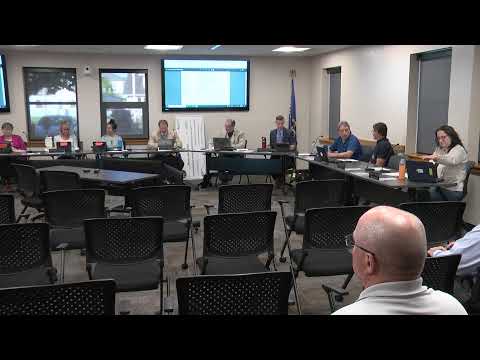
Donovan Group lead survey strategist Perry Hinder presented results of a community and staff survey the firm administered for the Wausau School District, saying 1,959 individuals completed the survey, "which is about 25% of the student population." The presentation was intended to inform whether the board should pursue an operational referendum on the November 2024 ballot.
Hinder described the methodology as a convenience sample (postcards mailed to every household with a unique URL and QR code) and said the report includes three groups of results: all respondents, a comparison group of district residents without direct ties to schools, and a weighted set that the consultant uses to approximate voting behavior. He emphasized participation benchmarks and cautioned that convenience samples can over‑represent staff and families.
Why it matters: the board is weighing whether to ask voters to raise the revenue limit to address persistent budget shortfalls. Hinder said the survey sets a ceiling for likely support and helps the district decide whether to move forward and on what terms.
Key findings and scenarios: Hinder reported that more than 54% of all respondents — and nearly 38% of the comparison group — said they were satisfied with the district. On the question of supporting an operational referendum in 2024, "more than 59% of all respondents and nearly 49% of the comparison group definitely or probably would support an operational referendum question on the '24 ballot," he said when results were unweighted; weighted results were under 53%.
Hinder then outlined three funding scenarios the survey tested: a $3 million-per-year, tax-neutral scenario (the most supported); a $6 million-per-year option with a modest tax increase; and a $9 million-per-year option with a much larger tax impact. "The numbers suggest that should you decide to place a question on the November 24 ballot, a non recurring referendum is the only 1 that has a chance of passing," Hinder said, summarizing the cross‑tabulations and the qualitative comments.
Public sentiment and qualitative themes: Hinder summarized open‑ended responses from about 950 respondents on district description and ~650 responses to an open request for additional feedback. Praise for staff and concern about teachers and student supports were common; qualitative themes also included questions about discipline, leadership stability, resource allocation and special‑education supports. Hinder recommended targeted community engagement — listening sessions, presentations to civic groups and clear messaging about tax impact and program trade‑offs — before placing a question on the ballot.
Board discussion: members focused on turnout and how the survey mapped to likely voters. One board member asked whether the firm had surveyed other nearby districts; Hinder said the firm had not done Eau Claire but cited Middleton (a district he worked with) as a comparative example. Directors also pressed for clarity on the difference between a tax increase and bill‑rate neutrality and about the demographic weighting process.
Next steps: Hinder recommended additional engagement to raise support and suggested the board has time to review and decide; he said the district could continue discussing options and, if the board chose to proceed, would need to work with bond counsel and approve a resolution by mid‑summer to meet November ballot deadlines.
The board did not make a decision at the meeting; the discussion closed after Q&A with the consultant.