Get Full Government Meeting Transcripts, Videos, & Alerts Forever!
Manhattan Beach unveils proposed citywide development impact fees; council hearing set for Jan. 13, 2026
Summary
City finance staff and consultants presented a comprehensive impact-fee study proposing per-square-foot and per-meter fees to cover capital costs from anticipated housing growth; the study cites examples such as a roughly $40,200 fee for a 3/4-inch water meter and an estimated Quimby parkland acquisition fund of about $25 million. The city will review the study at a finance subcommittee Dec. 18 before a council hearing on Jan. 13, 2026.
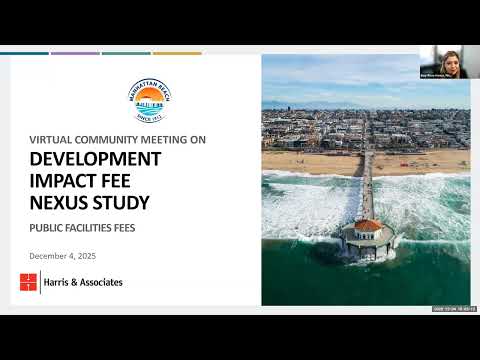
City officials and consultants on Wednesday laid out a comprehensive development impact fee study for Manhattan Beach that would replace the city’s old residential unit fee and set new charges across utilities, public safety, parks and transportation.
"The goal is for new development to pay their fair share of the cost and impacts they’re creating," said Emmy Rose Hanna, financial services manager for the city’s finance department, at the outreach meeting. Hanna introduced Harrison Associates as the consultant team leading the study.
Adam Marston, project manager with Harrison Associates, said the study was prepared under California’s mitigation fee framework and related amendments (referenced in the presentation as Assembly Bill 1600 and Assembly Bill 602). Marston told attendees impact fees are one-time charges intended only to fund capital projects attributable to new development and generally cannot be used for maintenance or personnel costs.
The study estimates Manhattan Beach could add roughly 2,012 housing units over the next 15 years and maps fee calculations to three methodologies: an existing-inventory approach (used for police, fire and general government facilities), a planned-facilities approach (used for Quimby parkland in-lieu and parks…
Already have an account? Log in
Subscribe to keep reading
Unlock the rest of this article — and every article on Citizen Portal.
- Unlimited articles
- AI-powered breakdowns of topics, speakers, decisions, and budgets
- Instant alerts when your location has a new meeting
- Follow topics and more locations
- 1,000 AI Insights / month, plus AI Chat