Get Full Government Meeting Transcripts, Videos, & Alerts Forever!
Get email alerts on the Development Impact Fees topic
No spam. Unsubscribe anytime.
Manhattan Beach unveils proposed citywide development impact fees; council hearing set for Jan. 13, 2026
Summary
City finance staff and consultants presented a comprehensive impact-fee study proposing per-square-foot and per-meter fees to cover capital costs from anticipated housing growth; the study cites examples such as a roughly $40,200 fee for a 3/4-inch water meter and an estimated Quimby parkland acquisition fund of about $25 million. The city will review the study at a finance subcommittee Dec. 18 before a council hearing on Jan. 13, 2026.
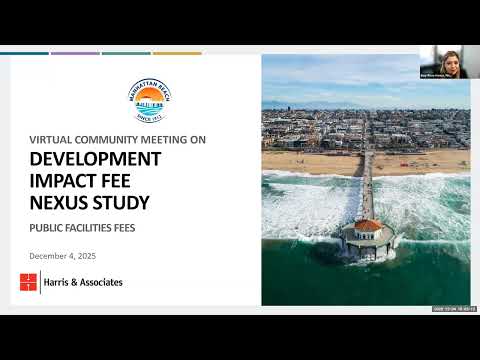
City officials and consultants on Wednesday laid out a comprehensive development impact fee study for Manhattan Beach that would replace the city’s old residential unit fee and set new charges across utilities, public safety, parks and transportation.
"The goal is for new development to pay their fair share of the cost and impacts they’re creating," said Emmy Rose Hanna, financial services manager for the city’s finance department, at the outreach meeting. Hanna introduced Harrison Associates as the consultant team leading the study.
Adam Marston, project manager with Harrison Associates, said the study was prepared under California’s mitigation fee framework and related amendments (referenced in the presentation as Assembly Bill 1600 and Assembly Bill 602). Marston told attendees impact fees are one-time charges intended only to fund capital projects attributable to new development and generally cannot be used for maintenance or personnel costs.
The study estimates Manhattan Beach could add roughly 2,012 housing units over the next 15 years and maps fee calculations to three methodologies: an existing-inventory approach (used for police, fire and general government facilities), a planned-facilities approach (used for Quimby parkland in-lieu and parks development), and a system-plan approach (used for transportation, storm drainage, water and wastewater). A 5% administrative component is added to each fee to cover program administration and reporting.
Examples provided in the presentation include:
- Quimby parkland in-lieu: Using a Quimby standard of about 1 acre per 1,000 new residents and an assumed acquisition cost cited in the presentation, the consultants estimated roughly a $25 million acquisition need and derived an approximate figure of about $5,500 per anticipated resident before converting to per-unit and per-square-foot charges.
- Parks development (amenitization): Using an assumed improvement cost of about $2,000,000 per acre, the study estimated a future park improvement fund just under $13 million and a per-resident figure of about $2,800 that is then converted into per-unit and per-square-foot fees.
- Public safety and general government: The presentation reported a replacement valuation of about $65.6 million for general government facilities, producing an estimated level of service near $1,500 per resident (workers weighted at 0.37); police replacement value was presented at about $33.6 million (roughly $813 per resident) and fire calculations yielded about $747 per resident. Those per-capita figures were turned into land-use fees using persons-per-household and employees-per-thousand-square-feet assumptions.
- Transportation: The consultants reported roughly $22.3 million in future transportation projects and an existing transportation replacement value around $106 million, producing an estimated cost per PM peak trip of about $3,500; that per-trip cost is applied to trip generation rates to derive fees by land use.
- Water: The presentation listed an existing water system valuation of about $528 million plus about $62 million in future projects for a total of roughly $590 million, which the study divided by buildout water demand to estimate about $40,200 per equivalent dwelling unit (EDU). Under the study’s EDU assumptions, a single-family home was equated to a 3/4-inch meter, producing an example fee of about $40,200 for that meter size.
- Wastewater: Consultants reported approximately $166 million in existing wastewater assets and about $45 million in future needs for a $212 million total system cost, yielding about $105,000 per EDU. Converted by assumed densities (for example, the presentation cited 8.1 single-family units per acre), the study derived example per-unit fees (the presentation cited roughly $13,000 per single-family unit before conversion to a per-square-foot basis).
- Storm drainage: The study placed total drainage costs at just under $120 million with about 980 impervious acres at buildout, producing a cost per impervious acre of roughly $121,000 that is then scaled by land-use imperviousness factors to derive fees.
Marston and Hanna outlined next steps: the study will be reviewed by the city finance subcommittee on Dec. 18 and is scheduled for a city council public hearing on Jan. 13, 2026. If council adopts the fees as proposed, they would take effect about 60 days after adoption (projected March 2026).
On a public question about grandfathering, Hanna said projects with permits or applications already submitted and underway before the fees become effective would not be subject to the new fees; fees would apply to applications submitted after the effective date and would generally be locked at application but paid at certificate of occupancy, with utility fees (water, sewer, storm drain) collectible earlier as noted in the presentation.
The presentation and full nexus study will be posted at www.manhattanbeach.gov/impactfees, Hanna said, and the city encouraged affected parties to attend the upcoming finance subcommittee and council meetings for further questions and potential modifications.