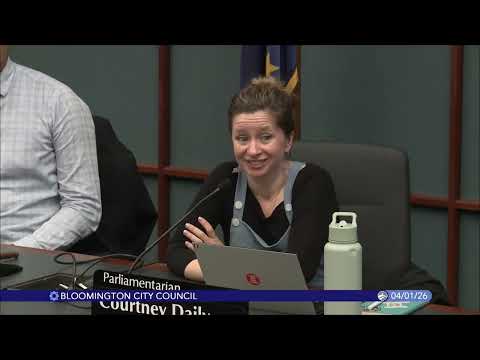
Council delays Hopewell PUD vote after hours of debate over affordability, sidewalks and fire access
Loading...
Summary
After a lengthy exchange between the mayor, project representatives, city and RDC attorneys, and dozens of public commenters, the Bloomington Common Council postponed a final vote on the Hopewell PUD to April 22 to allow more time to resolve affordability and technical conditions.
Bloomington Mayor Mary Thompson asked the Common Council on Tuesday to delay a final vote on the Hopewell planned‑unit development unless members were prepared to adopt no material changes to the developer’s submission. “Unless you plan to vote without… materially changing what has been submitted, I would ask you not to vote on it,” Thompson said, urging council members to use April meetings to hammer out details.
Council members spent more than four hours weighing a bundle of 13 “reasonable conditions” that would alter the PUD’s affordability commitments, street sections and other technical standards. Sponsors of the most ambitious affordability proposal — which would require 50 percent of the PUD’s homes be permanently affordable (15 percent at or below 90 percent AMI and 35 percent at or below 120 percent AMI) — said the mandate would preserve long‑term access to homeownership on city‑owned land. “We have an opportunity here because the city owns this land,” Council member Rosenbarger said, arguing the council should seek a higher share of permanently affordable units.
Redevelopment Commission counsel and the city’s assistant attorney warned the council that some of the proposed changes could legally amount to an amendment to the PUD rather than a permissible condition. “We believe that this is legally classified as an amendment,” Dana Kerr, the city’s assistant attorney representing the RDC, told the council, saying a strict permanent‑affordability mandate that changes ordinance text or exhibits could not be unilaterally imposed without the petitioner’s consent.
Project representatives and the petitioner’s consultant repeatedly described trade‑offs. Ali Quinlan Thurman, who presented the PUD design and its exhibit set, said increasing sidewalk widths, tree‑plot requirements or minimum permanent‑affordability targets would reduce the parcel’s developable footprint and raise per‑unit costs, forcing redesigns and possible return to plan commission. “The more requirements that we have, the fewer homes that we can have and the higher the costs are,” Thurman said, noting some changes would require reworking exhibits and recalculating stormwater and accessibility allocations.
Lenders and community‑housing practitioners — including Summit Hill Community Development Corporation’s Nathan Ferrer and representatives of local banks — told the council some permanence mechanisms, such as ground leases and land‑trust models, can work but require underwriting adjustments and program capacity. Ferrer said the land‑trust ground‑lease model has proven feasible for a subset of buyers but has required sustained effort to secure lenders willing to underwrite non‑standard mortgages.
The council also debated streetscape and public‑safety items. Sponsors pressed for a 6‑foot sidewalk plus tree‑plot sections in neighborhood streets and sought to narrow internal alley widths to preserve lots; the fire chief and staff explained that narrower alleys could trigger automatic‑sprinkler requirements or other technical mitigations. Fire Chief Roger Kerr said sprinkler systems are an available alternative but warned about monitoring and maintenance burdens and provided a planning‑level cost range that staff and designers said would materially affect the project budget.
With no clear settlement and a mix of legal and technical questions unresolved, the council moved to postpone the ordinance. Council member Zulek made a motion, which the council adopted, postponing Ordinance 2026‑06 to the council’s April 22 regular meeting and asking staff, the RDC and council committees to use the intervening weeks to refine the conditions and any technical exhibits.
The postponement preserves the option for the council to return with a set of conditions the petitioner can accept; it also leaves open the possibility the RDC could withdraw the petition if the council adopts conditions the petitioner finds unacceptable. The council scheduled further deliberations and signaled a willingness to continue negotiating whether and how to marry high unit counts with stronger permanent‑affordability protections.
What comes next: the council set a deliberation window and asked staff and the RDC to return with clearer cost estimates and legal guidance on which proposed conditions are implementable without amending the PUD text. The council will take up Ordinance 2026‑06 again at its April 22 meeting.