Get Full Government Meeting Transcripts, Videos, & Alerts Forever!
Get email alerts on the Parks Cip topic
No spam. Unsubscribe anytime.
Benton City park board details repairs and capital plan, cites parkland shortfall and grant pushes
Summary
At its March 31 meeting the Benton City Park Board reviewed condition assessments for the city’s parks, prioritized short‑term repairs and several capital projects — including court resurfacing and a splash pad — and discussed ongoing grant applications and a developer fee program as the city seeks more park acreage.
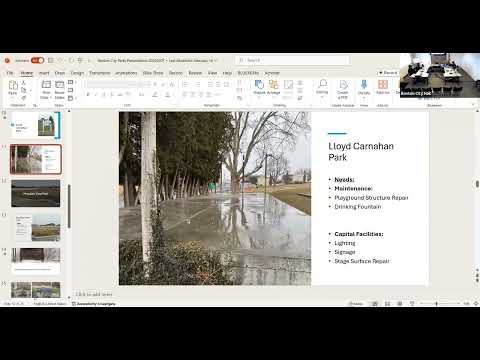
The Chair opened the March 31 Benton City Park Board meeting and presented a condition assessment of the city’s parks, saying the municipality is “about half the parkland we’re supposed to have in city limits.” The report identified maintenance work — broken drinking fountains, worn parking‑lot striping and playground surfacing — along with longer‑term capital needs such as restroom facilities, court resurfacing and playground replacements.
The board identified Wood Carnahan Park (formerly City Park) as a top capital priority for event space repairs and public amenities, and the Chair said council has approved funding to convert inoperable tennis courts at the skate/tennis complex into pickleball courts; contracting for fencing is underway and resurfacing contracting will follow after council approval. The chair also said the city has an application pending for a splash pad north of the Kibbe Market and is high on the list awaiting legislative approval.
The presentation emphasized grant and funding strategies. The chair said the city applied for a $50,000 grant to build an access gravel road and signage for Riverfront Park, and earlier applied for a $1.2 million grant for sports fields that was not awarded. The chair also cited a roughly $2 million HUD grant related to purchasing and refurbishing a nearby railroad bridge into a pedestrian pathway. The chair told members the grantor has indicated that installing a road and signage would qualify the Riverfront property as a park under the acquisition agreement, which must be satisfied by 2026.
Board members discussed funding tradeoffs for new developments. The chair said the city accepts either land dedication or a parks fee from developers and that the current developer parks fee is, as reported in the meeting, 10 cents per acre; the chair cited Cherry Grove as an example that paid about $500,000 instead of dedicating land. Members discussed whether to increase the fee or require more developed parkland from builders.
Safety and operations issues were also raised: Legion Park, across from the high school, was highlighted for a need for a permanent restroom (the site currently relies on porta‑potties), and the board agreed to prioritize playground surfacing at small neighborhood parks that lack fall protection. Committee members and residents noted poison hemlock in riparian areas and agreed to coordinate with Benton County noxious‑weed control and Department of Fish and Wildlife on treatment and permitted work in habitat zones.
The chair closed by asking board members to visit park sites and submit naming suggestions and improvement priorities; the board set its next meeting for early June. No formal votes or motions were recorded at the March 31 meeting.