Bangor council debates $75 million parks-and-recreation bond, cites voter-approval requirement and cost risks
Loading...
Summary
City staff presented a $75 million bond and ballot language for a new parks-and-recreation facility, and councilors raised concerns about the price tag, referendum timing and the need for clearer funding strategies if voters reject the measure.
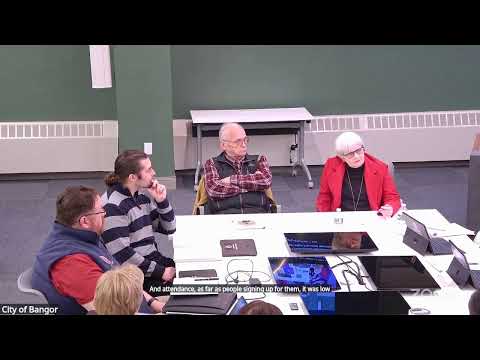
City Manager Lehi told the Bangor City Council at a March 23 workshop that two agenda items would come before the council: a second reading to authorize the bond issuance and approval of the ballot language for a proposed parks-and-recreation facility. She cautioned that, under the city’s ordinance, any bond issuance above the local threshold also requires a voter referendum, meaning a council vote alone would not allow staff to issue the bonds.
The council heard an extended debate on the project’s scale and fiscal risk. "Voting yes on the $75,000,000 issuance would not be enough for city staff to go out and get the $75,000,000," City Manager Lehi said, explaining the ordinance and the requirement for a voter approval because the authorization exceeds the city’s threshold. Council members said the $75 million price tag prompted unease about the consequences if voters reject the measure and about the city's capacity to absorb cost increases.
Council member (S7) said the project is needed but warned of unpredictable cost pressures tied to broader economic conditions and global supply chains, noting concerns about rising energy and construction costs. "The price tag, I'm very worried," the councilor said, adding that the council might prefer a different plan or to seek other funding windows, including future federal opportunities.
Other councilors urged staff and the community to consider additional funding strategies, including targeted sponsorships, capital campaigns or booster clubs, and to test a reduced-scope model that prioritizes urgent components such as childcare spaces and ice facilities. One councilor suggested a community-led capital campaign could reduce the city’s share of the cost.
Several council members and staff also discussed how a defeat at the ballot box would affect timing: City Manager Lehi read the city’s ordinance and clarified that a voter-approved ordinance cannot be amended or repealed by council for three years from enactment, but that restriction applies only if voters approve a measure; if voters reject a measure, the council could revisit the question sooner. That clarification shaped some members’ arguments about whether to present the item in its current form or return to town-hall-style workshops to refine scope and funding.
Councilors requested a follow-up workshop or a GovOps meeting to develop clear expectations, a funding checklist and to identify grants or partnerships before returning the bond authorization to the council. The staff said they will plan to provide additional financial detail and possible alternative funding stacks if the council requests them.
The item remained under debate at the workshop; no final vote on the bond authorization or the ballot language was recorded during the workshop.
Ending: The council directed staff to provide additional financial detail and to schedule a follow-up workshop if the item is not ready for final approval; a voter referendum would be required before the city could issue bonds if the measure proceeds to the ballot.