Get Full Government Meeting Transcripts, Videos, & Alerts Forever!
Get email alerts on the Transportation topic
No spam. Unsubscribe anytime.
Superintendent outlines costly bus options as parents urge safer routes
Summary
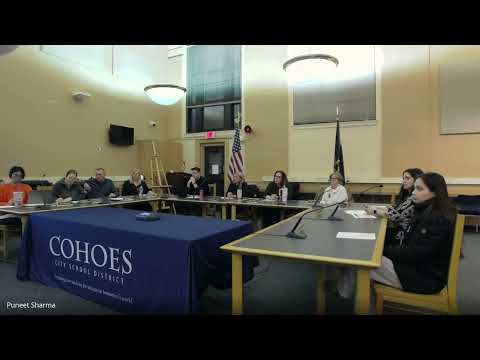
At the March 4 Cohoes City School District board meeting, Superintendent Miss O'Shea outlined options and costs for providing districtwide student transportation — including $3.5M–$5M annual estimates for contracted service and added capital needs for electric buses — while parents urged immediate action on safety concerns.
At the March 4 Cohoes City School District Board of Education meeting, Superintendent Miss O'Shea told board members that the district is weighing two main options to expand student transportation: build an in-house fleet or contract services. She said a contracted program for a district of Cohoes’s size would likely cost between $3.5 million and $5 million a year.
"The typical transportation program, for a district our size, if we contract the service, would be between 3 and a half million and $5,000,000," Miss O'Shea said. She warned that new zero-emission (electric) bus requirements add capital costs for vehicles and charging infrastructure and could increase future contract prices.
O'Shea and district staff explained the legal and funding constraints that shape options. Under state education law, students in K–6 who live more than 2 miles, and students in grades 7–12 who live more than 3 miles from school, may be eligible for aidable transportation; the district’s compact, city geography means most residents fall inside those radii and would not attract state aid. "Most districts in the capital region have an aid ratio for transportation that ranges from 70 to 90%," the superintendent said, but she noted that the city’s small radius limits the amount of aid the district could receive.
Board members and community members raised concerns about both fiscal and safety tradeoffs. One board member said it would be difficult to reallocate $3.5M–$5M a year away from academic supports given existing student needs. "I would struggle to spend 3 and a half to 5 and a half million dollars a year after listening to our request tonight where our students are so struggling academically," the board member said.
Public commenters pressed the board to prioritize student safety. Andrew Seagerdorf, a Cohoes resident, praised the district’s engagement and said he had prepared a community-level, no-cost proposal to help children get to school safely. "That proposal... cost $0," Seagerdorf said, and he called for collaboration with churches and the city to create community solutions and warming stations.
Parent Danielle Malcolm described daily safety risks for children walking to school in winter conditions and urged the board to act. "It cost me hundreds of dollars to get my children to school safely," Malcolm said. "Kids are walking in the road with traffic and other cars slip sliding on the ice... 30 to 40 minutes one way for an elementary school student, in my opinion, is too long. It's not safe."
District leaders outlined next steps: obtain more detailed cost estimates for contracted routes and potential in-house operations, follow up with regional partners (including CDTA) about route alignment, and gather data on specialized-route needs. The superintendent said the district is open to exploring alternative, lower-cost community options such as walking-school routes or local warming stations while pursuing a fuller fiscal analysis.
The board did not take a formal vote on a transportation policy at the meeting; the administration said more information will be provided to the board as it narrows options.