Lawmaker urges $1.5 trillion prefunded investment fund to shore up Social Security
Loading...
Summary
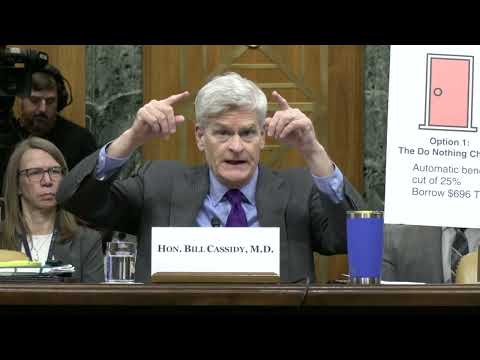
A lawmaker told the Senate committee that Social Security faces a long-term shortfall and proposed a separate, $1.5 trillion prefunded investment vehicle held in escrow for 75 years as a bipartisan way to reduce future benefit cuts.
A lawmaker speaking to the Senate committee warned that Social Security faces a large, long-term funding shortfall and urged Congress to create a separate, prefunded investment vehicle to reduce the risk of future benefit cuts.
The lawmaker, addressing Chairman Graham, Ranking Member Merkley and colleagues, said the Social Security Trustees report shows payroll tax revenue will fall short of covering expected benefits by more than $25,000,000,000,000 over the next 75 years and added an inflation-adjusted figure he characterized as $674,000,000,000,000. He said that under current law benefits would have to be cut to match available income, citing actuaries’ estimates of a 23–26% reduction and the Congressional Budget Office’s 28% estimate.
To avoid those cuts, the lawmaker proposed what he called a “safe, strengthen, and secure” option: a diversified investment fund kept separate from the Social Security Trust Fund, prefunded with $1,500,000,000,000 and invested in a manner similar to private retirement funds. He said the fund would be held in escrow for about 75 years so its internal rate of return could help offset borrowing needed to pay scheduled benefits.
The speaker pointed to a precedent in 2001, when Congress permitted the Federal Railroad Retirement System’s corpus to be invested, and said that vehicle has since grown and is now solvent. He argued the proposed vehicle would be modeled on the same public- and private-sector investment practices and said polling shows broad public support for such an approach.
The lawmaker emphasized governance measures he said would be required: annual audits, full transparency and strict guardrails to limit congressional interference in management. He framed the proposal as both a policy and political choice and urged action soon, saying delay would make the problem harder to solve for current and future beneficiaries.
The committee did not vote on a measure during these remarks; the proposal was presented as a policy option for committee consideration.