Get Full Government Meeting Transcripts, Videos, & Alerts Forever!
Get email alerts on the Local Government Reform topic
No spam. Unsubscribe anytime.
Granite County advisory panel reviews survey showing opposition to charter, support for shorter commissioner terms; public hearing set for March 11
Summary
A Granite County advisory panel reviewed a countywide survey of 304 respondents and agreed to post results, seek legal counsel to clarify ballot language, and hold a first public hearing on proposed government changes on March 11 at 6 p.m.
A Granite County advisory panel reviewed countywide survey results at its Feb. 11 meeting and set a public hearing for March 11 at 6 p.m. to present findings and take public comment.
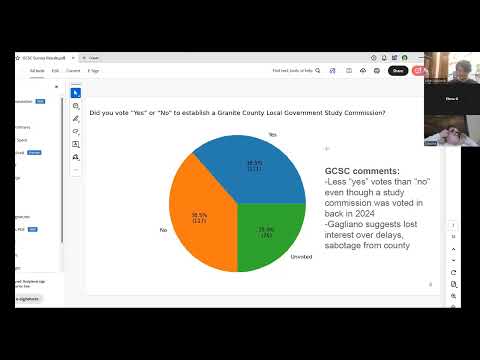
The panel’s presenter, Luke, said 304 residents responded to the survey out of 2,423 active registered voters. He reported that the question “Should the county spend resources to establish a charter?” polled overwhelmingly no (69.4%), and a related question about adopting self‑governing powers registered roughly 68.8% no. By contrast, shortening county commissioner terms from six years to four drew the most support, with 63.8% yes and 32.2% no (12 unvoted).
“These numbers are the ones we have to look at and work with,” Luke said, noting the results are a sample of the population. He also placed the relevant Montana code (MCA 7‑4‑2105) in the survey packet for commissioners to review.
Panel members debated how to interpret the sample size. Blanche argued the raw number of respondents — roughly 260–304 depending on the question — did not constitute a countywide majority and urged caution about relying on the survey alone to determine ballot placement. “You’re looking at 260 voters out of 3,000 that turned in their surveys. That is not a majority,” Blanche said. Luke and others replied that survey percentages can be extrapolated and that the results show meaningful public interest on some issues.
The group also reviewed other structural questions from the survey: appointing department heads rather than electing them was unpopular, an elected county executive polled poorly, and a hired county manager drew somewhat more interest. Panelists agreed these items were clear in the results and that they required no further immediate action.
Elena volunteered to transcribe and chronicle verbatim public comments for the record and to prepare handouts and graphics for the public hearing. Luke said he would prepare pie charts and distribution materials; commissioners requested the handout package be circulated to all members before it is published online or printed for the hearing.
On legal questions, commissioners asked staff to seek counsel to clarify what statutory steps, if any, would be required to change commissioner term lengths and how ballot language should read. Luke noted the MCA provision in the packet and agreed legal advice would be prudent before finalizing any ballot measure.
The panel voted to set the advisory body’s first public hearing for March 11 at 6 p.m.; the motion carried by voice vote. Members discussed the legal notice requirement — two consecutive weeks in the local newspaper — and asked that the published notices and an explanatory column accompany the formal notice.
The meeting closed after brief additional public‑comment discussion and was adjourned by unanimous voice vote. The panel said materials for the March 11 hearing will be prepared and circulated to commissioners for review prior to publication.
What’s next: the panel will seek legal counsel to clarify statutory requirements and finalize ballot wording if any proposal is recommended; commissioners will post hearing notices in the local newspaper and distribute handouts before the March 11 hearing.